
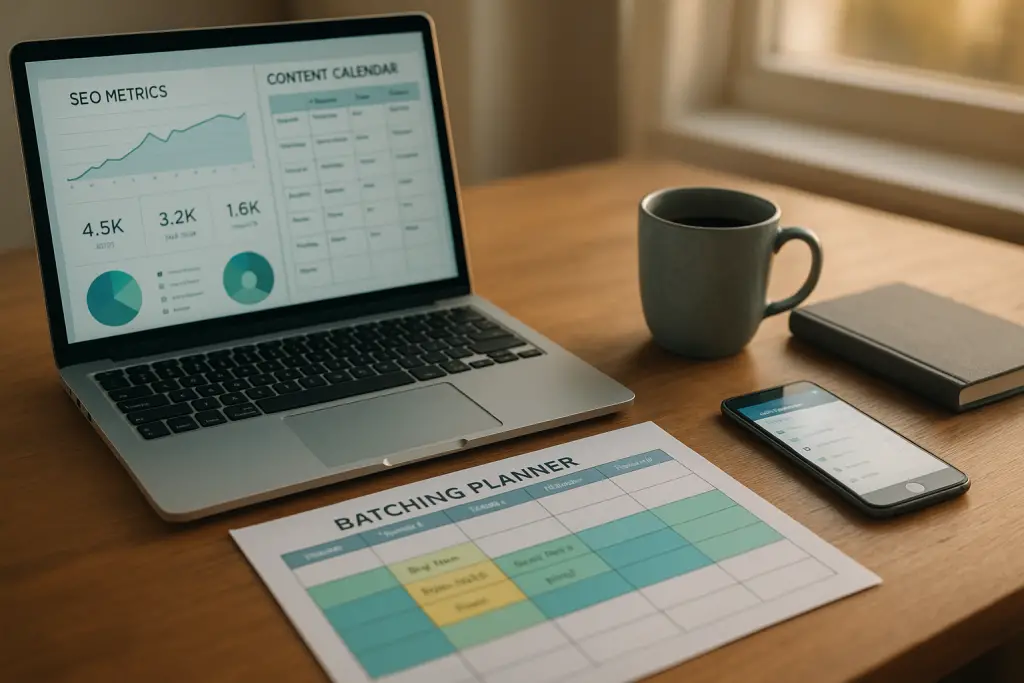
The honest SEO answer to “how often should you blog” (quality, intent, and resources beat arbitrary schedules)
If you came here hoping I’d say “three posts a week, no exceptions,” I’m going to lovingly disappoint you. As a musician-turned-SEO who coaches creatives to build sustainable businesses, I’ve learned that the right blogging frequency isn’t a magic number—it’s a strategic fit. Search engines don’t reward you for posting on Mondays at 9 a.m.; they reward you for satisfying search intent with helpful, original content that demonstrates experience and expertise. In plain English: publish something worth saving and sharing, and publish it consistently enough that you can maintain that standard without burning out.
For creatives—coaches, teachers, artists, designers, photographers—this matters even more. You’re not a newsroom. You’re building a business that supports your life, not the other way around. That’s why I rely on content batching and SEO together. Batching protects your energy and lifts the quality of each piece. SEO makes sure that quality is discoverable, compounding into sustainable traffic that sells your offers while you’re in the studio, on stage, or on vacation.
Here’s how I answer the “how often should you blog?” question: pick a cadence you can keep for six months without hating your life. Then use batching to make each post exceptional—aligned to keywords that match the questions your buyers are already typing, structured for readability, and supported by multimedia that proves you’ve done the work. Some niches benefit from weekly posts; others win with one deep post every month plus smart refreshes. The lever isn’t volume; it’s relevance multiplied by consistency. And yes, I’m going to show you ten practical ways to find that lever and pull it—hard—without slipping back into hustle culture.
Before we dive in, grab my free SEO cheatsheet. It walks you through on-page basics you’ll use in every single post you batch, from titles to internal links. It’s built for creatives, not tech bros, so it won’t make your eyes glaze over.
Choose a publishing cadence that matches your niche, competition, and capacity
There’s a huge difference between teaching local violin lessons and running a global digital art course. Your ideal blogging frequency should reflect the search landscape you’re entering, who’s already winning those results, and what you can realistically produce. A painter going after “how to price watercolor prints” doesn’t need the same output as a productivity blogger chasing fast-moving software tutorials. Start with the market, then check your bandwidth, then lock a cadence that threads the needle.
Benchmark against search intent and competitor velocity, not myths about frequency
When I plan a publishing schedule with clients, we audit search intent and competitor behavior first. If the top results for your target keywords are evergreen guides—think “how to start a private voice studio” or “beginner lighting for portrait photography”—you’ll likely win with fewer, deeper posts that become definitive resources. If your queries change rapidly (e.g., “YouTube Shorts dimensions,” “Instagram Reels length”), your niche rewards timely updates. In those cases, frequency helps, but only because it’s tied to freshness where searchers expect it.
Look at your primary keywords and classify them. Which are evergreen “fundamentals” that need a single excellent guide and light maintenance? Which are seasonally fresh (holiday gift guides for artists, back-to-school music practice plans)? Which are fast-changing (platform specs, tool comparisons)? Now peek at the sites consistently ranking top 5. How often are they publishing new or updated pieces in your topic cluster? What’s the average word count, media use, and depth? If the leaders post weekly but their content is thin, you can outrun them with fewer, stronger posts. If the leaders post sparingly but each article is a masterclass, match that energy rather than chasing a number.
Here’s the secret sauce: velocity matters only relative to quality. One polished, search-aligned article that answers a pain point—“how to budget a creative business,” “what to put in a photography client contract,” “curriculum for beginner piano course”—will outperform four rushed posts you dashed off at midnight. Your audience can tell. So can search engines.
Adopt a weekly or monthly model with realistic outputs for creatives and small teams
Most creative businesses thrive on one of two cadences: weekly or monthly. Weekly works when you’ve batched a quarter’s worth of outlines and assets, and you’re prepared to hit publish without sacrificing your client work or mental health. Monthly shines when you commit to a true pillar post—3,000 words of lived experience, killer examples, and original visuals—plus light touch-ups to supporting content.
If you’re solo, I often recommend a hybrid: publish two substantial posts per month and refresh or repurpose one older asset. That’s three “content moments” a month without sprinting on a hamster wheel. If you have a small team or you’re using AI as a first-draft assistant, a steady weekly cadence is achievable—provided you keep a firm editorial bar and a review process. Don’t outsource your voice. Let tools help with ideation and structure; you bring the stories, the screenshots, the proof.
A quick reality check I give my coaching clients: imagine your busiest season. Recitals. Holiday commissions. Launch week. Can you still meet your planned cadence then? If not, it’s too aggressive. Dial it back, batch more, and protect your margin. Sustainable beats sporadic, every time.
Batch your content so quality scales without burnout
Content batching is how you turn “I should blog more” into a reliable system that respects your brain. When you switch from single-article sprints to themed production blocks, you cut context switching, make smarter editorial decisions, and build topical authority—the fancy SEO way of saying “Google can tell you really know your stuff.”
Plan theme sprints: map keywords to pillars and briefs, then outline multiple posts at once
I like to work in four- to six-week sprints around a single theme. Say you’re a music teacher focusing on “beginner piano.” Your pillar might be “How to Teach Beginner Piano at Home: A Complete Guide.” Supporting posts could include “Beginner Piano Practice Routine by Age,” “How to Choose a Beginner Keyboard (On Any Budget),” and “First Five Songs to Motivate New Pianists.” The keywords differ, the search intents vary slightly, but together they form a cluster that signals expertise.
Start with a lightweight keyword map. Pick one main keyword per article and 2–4 semantically related phrases you’ll naturally cover. Jot down the primary search intent (informational, transactional, comparison) and the “job to be done” for the reader. Build a one-page brief for each post: working title, angle, questions to answer, examples to include, and any assets you’ll need (photos, charts, short demo videos). If you use AI, have it produce draft outlines based on your brief so you’re never starting from a blank page. Then, across a single planning day, outline three to six articles in the theme. You’ve just eliminated the scariest part—getting started—while keeping each piece coherent and distinct.
Because you’re a creative, make your outlines visual. I’ll sketch a quick flow on my iPad, note where a staff line image or chord chart fits, or mark up a screenshot sequence for a tech tutorial. These small choices add lived experience, which search engines (and humans) increasingly prioritize over generic summaries.
Create in focused blocks: draft, design, and multimedia production sessions that cut context switching
Once your outlines are tight, divide production into blocks that match your energy. One block is for drafting (just words, no formatting). The next is for design and multimedia: images, charts, scores, short clips, GIFs of your editing workflow. Another is for editorial polish: intros that hook, headings that reflect your keyword phrasing without sounding robotic, and conclusions that nudge readers to your offers.
I’ll often draft three articles across two mornings, then record all supporting media in a single afternoon while my voice and lighting are already dialed in. The next day is polish and packaging—titles, meta descriptions, alt text, internal links to your products or lead magnets. This sequence makes you frighteningly efficient without sacrificing soul.
Because batching magnifies quality, your readers feel it. They’ll notice your recurring motifs—the way you break down a technique, your studio stories, your screenshots that make a complex step look easy. That brand consistency becomes a moat competitors can’t automate.
A quick checklist I keep taped to my monitor during production:
- Does this post present an original angle, example set, or demo that proves I’ve actually done the work?
- Are my headings scannable, aligned to intent, and written like a human would talk?
- Did I include at least one internal link to a product, course, or free resource, and one to a related pillar or support post?
Use it. Tweak it. Make it yours.
Schedule and safeguard quality: internal linking, on-page SEO, and compliance with Google’s scaled-content and site-reputation policies
Your publishing calendar isn’t just dates—it’s a quality-control system. Before anything goes live, run through on-page SEO basics: a clear H1 that mirrors the core query without stuffing; descriptive H2s; concise meta titles and descriptions that earn the click; image alt text that actually describes the image; short URLs that echo the topic. Then weave internal links. Link up to your pillar article and down to support posts, and connect horizontally across related guides. Internal links distribute authority, help readers go deeper, and reduce bounce because people find exactly what they came for—plus a little extra.
Equally important, protect your site’s integrity. Avoid “scaled content” traps where dozens of thin articles are churned out with minor variations. Don’t publish unvetted guest posts just to fill your calendar. If you use AI for speed, always add first-hand examples, screenshots, or data from your own studio or business. That’s how you demonstrate experience and expertise, not just regurgitation. You’ll sleep better, your readers will trust you, and you’ll stay on the right side of evolving search quality systems.
Finally, schedule smart. Load your finished posts into your CMS with featured images, related posts modules, and CTAs that match the article’s stage of awareness. If a guide sits top-of-funnel, the CTA might be your free SEO cheatsheet. For a how-to that solves a painful problem, the CTA might be your workshop or template bundle. Publishing isn’t the finish line—it’s the starting pistol for discovery and conversion.
Sustain topical authority with smart updates, audits, and measurement
Blogging isn’t a one-and-done project. Your best-performing posts become assets you tune like an instrument—carefully, methodically, with an ear for what the audience needs right now. The win isn’t posting more; it’s maintaining the pieces that already win while adding new content that fills strategic gaps.
Refresh where freshness matters (QDF queries), repurpose responsibly, and run quarterly content audits tied to outcomes
Some topics deserve freshness (yes, that’s a real thing search engines consider for certain queries). If you teach YouTube for creatives, your specs and best practices change often. Those posts should get scheduled refreshes: update screenshots, validate steps, re-check dimensions or time limits, and bump the “last updated” date only when you’ve made meaningful changes. Other posts—like your definitive “how to price your art prints”—should evolve slowly, with updates focused on examples, pricing tables, or new client stories rather than chasing every micro-trend.
Repurpose with intention. A deep blog post can become a YouTube tutorial, a podcast episode, or a carousel. But keep the blog post the canonical source. Embed the video back into the post to increase time-on-page, and use the transcript to surface long-tail phrases your audience actually speaks. If you’re podcasting, create a show-notes version that links back to the master guide, not a duplicate article. You’re building one strong signal, not fracturing it across platforms.
Every quarter, run a simple content audit. Export your posts, map each one to a pillar or support cluster, note primary keyword targets, and pull key metrics: clicks, impressions, average position, and conversion actions (email sign-ups, product views, course checkouts). Ask better questions than “did traffic go up?” Which content clusters are pulling their weight? Which posts rank on page two for terms you could win with a stronger intro, better expertise signals, or clearer internal links? Which pieces bring qualified buyers—people who actually join your email list or buy a template—rather than drive empty pageviews?
To visualize the decision, use a straightforward table like this:
Notice how none of those actions require publishing five new articles a week. They require judgment—and a system.
Measurement keeps you honest. Set a simple dashboard that tracks:
- Publishing cadence vs. plan (did you hit weekly, biweekly, or monthly?).
- Organic clicks to your core offers (not just your blog).
- Email sign-ups attributable to top-of-funnel posts.
- Time to publish per article (are your batching gains real?).
If a monthly pillar plus two refreshes is growing traffic and sales, you’ve answered “how often should you blog” for your specific business. Keep that cadence. If growth stalls and competitor velocity rises in a fast-moving niche, test a temporary increase for one quarter—only after you’ve banked outlines, assets, and review capacity to keep quality high.
Here’s the mindset shift I coach: your blog is not your diary; it’s your silent salesperson. Consistency doesn’t mean “constant.” It means “dependable, high quality, aligned with what buyers search for.” Content batching is the engine. SEO is the steering wheel. Together, they get you somewhere worth going—without grinding your gears.
If you’re ready to map your first theme sprint, steal my outline framework from the free SEO cheatsheet. Pick one pillar your audience begs you to explain, list three support posts, and block two mornings next week just for drafting. Add one afternoon for media and one for polish. Then schedule those posts, build your internal links, and watch your site start pulling its weight while you do what you love. That’s not hustle—that’s sustainable momentum, and it’s yours to keep.