
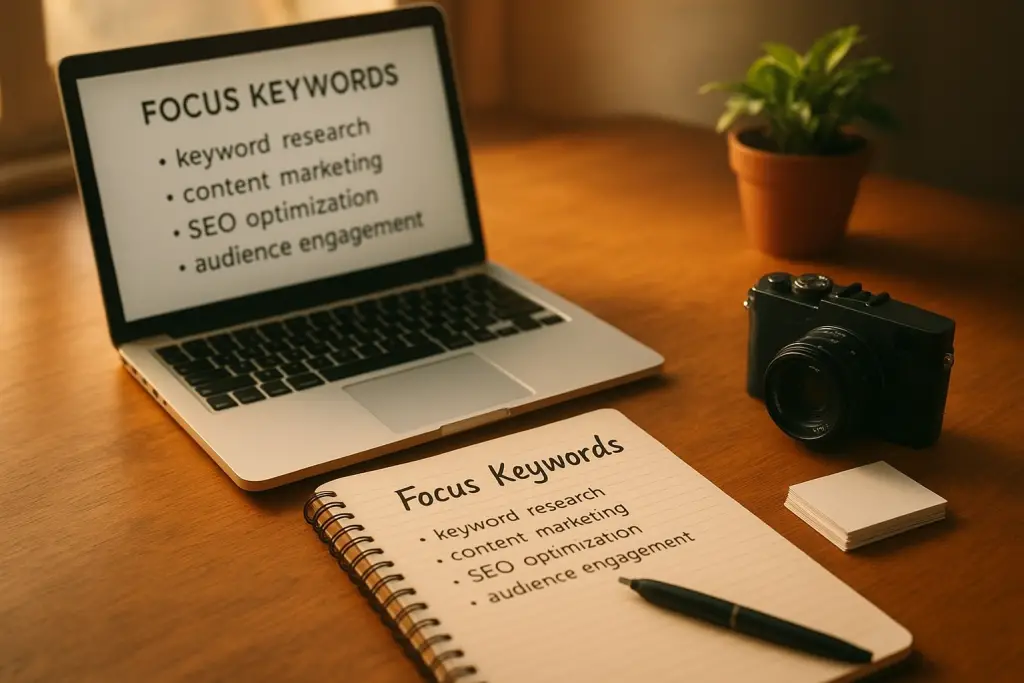
Why Focus Keywords Matter for Creative Entrepreneurs Who Want Passive Income
You don’t need to shout to sell out your offers. When your content is anchored by the right focus keywords, your blog posts, videos, podcast episodes, and product pages quietly work for you around the clock—bringing in the exact people who are searching for what you create. As a freelance musician turned SEO coach for creatives, I’ve watched photographers book out through a single tutorial that ranks, illustrators sell printables while they sleep, and music teachers convert a “how to practice scales” article into a full studio of ideal students. The common thread isn’t nonstop posting. It’s strategic focus keywords tied to clear offers.
Focus keywords are the phrases you choose to be discovered for. Pick them with intention and every piece of content becomes an asset that attracts aligned clients and buyers. I teach this because sustainable, passive income relies on discoverability. If a potential student or customer can’t find you when they search, you’re invisible—no matter how beautiful your work is. With the right focus keyphrase on each page, Google, YouTube, and podcast apps finally understand what you’re about. Better still, your audience does too.
Here’s the mindset shift: focus keywords aren’t just “SEO terms.” They’re your business strategy, your audience clarity, and your product roadmap in disguise. When you’re crystal clear on the phrases that signal intent—learn, try, buy, subscribe—you make smarter content, build better offers, and free up time for your art. Let’s turn those phrases into passive-income engines.
What Are Focus Keywords and How to Choose Them with Confidence
A focus keyword (or focus keyphrase) is the primary search term you want a page to rank for. Think of it as the North Star for that piece of content. Everything on the page—title, slug, headers, body copy, visuals, and calls to action—supports that single idea. If your article is “how to price watercolor commissions,” you don’t also try to rank it for “watercolor supplies list.” That splits the signal. One page. One goal. One intent.
Great focus keywords live at the intersection of three truths:
- Your audience is actually searching for the phrase.
- You can realistically rank for it with your current authority.
- Ranking for it aligns with a revenue path in your business.
If any one of those is missing, move on. Ranking for irrelevant terms is a time sink, and chasing high-competition vanity phrases stalls momentum. Confidence comes from choosing phrases that are both winnable and profitable for your creative business.
Match search intent so each page answers a clear user goal
Every search carries intent. People are usually:
- Learning: “what are focus keywords,” “best camera for beginners”
- Comparing: “Procreate vs Photoshop for illustrators”
- Doing/buying: “printable wedding seating chart template,” “online beginner piano course”
When your focus keyword aligns with the user’s intent, your content feels like an instant yes. A tutorial with a “learn” intent shouldn’t bait-and-switch into a sales page. It should teach thoroughly and then invite the reader to take a logical next step—download your checklist, join your studio waitlist, or preview your course. A product page with a “buy” intent must be concise, visual, and trust-rich; it shouldn’t ramble like a blog post.
Quick gut-check: read your focus keyphrase out loud and ask, “Is the person typing this ready to learn, compare, or buy?” Let that answer dictate the format, tone, and call to action on the page.
Prioritize long‑tail opportunities and realistic difficulty over vanity terms
Short, broad keywords (“music lessons,” “art prints”) are crowded highways. Long‑tail focus keywords (“jazz piano lessons for adults online,” “minimalist line art printable set”) are scenic routes with less traffic and higher conversion. They reveal the exact problem, style, or buyer moment your audience has.
You don’t need hundreds of high-volume phrases. You need a small map of specific, winnable focus keywords that match your offers. I like to evaluate three signals quickly:
- Specificity: Does the phrase include qualifiers—skill level, niche, style, location, or format?
- Competition: Could a creator with your current site authority break into the top 10?
- Monetization: If you ranked, what would you sell or promote there?
Your confidence grows when your focus keywords check all three boxes. Start with easier wins; momentum is a business asset.
A Time‑Saving Keyword Research Workflow for Busy Creatives
If your creative time is precious (and it is), your research process must be snappy and smart. Here’s the workflow I give my coaching clients—simple, repeatable, and designed to avoid content rewrites.
Use predictive search and related questions on Google and YouTube to uncover real phrases
Open Google and start typing your topic like a beginner would. Let autocomplete finish the sentence. Those suggestions are gold because they come from real searches. Click a likely phrase and scan “People also ask.” Every question there is a clue to intent and language. Do the same on YouTube; autocomplete surfaces video-first phrasing you can turn into tutorials, shorts, or livestreams.
Pull 10–15 promising focus keyphrases into a list. Say you’re a photographer selling presets and a Lightroom course. You might collect terms like “lightroom mobile presets for portraits,” “how to edit moody photos in lightroom,” and “lightroom batch editing for weddings.” These are not random. They point to real products, tutorials, and funnels you can build.
Validate difficulty and SERP quality, then map topics into clusters to avoid cannibalization
Before committing, peek at the first page of results (SERP). If you only see national brands or heavy-hitter domains, that’s a red flag. If results include indie creators, YouTube videos, or Pinterest posts, you likely have a shot. Next, assess quality: are top-ranking articles thin, outdated, or missing crucial steps? That’s an opening.
Now cluster your list. Group related focus keywords under one core idea (pillar), then plan supporting content that links back to the pillar. This prevents keyword cannibalization—multiple pages competing for the same phrase—and gives your site topical depth.
Here’s a simple way to think about clustering focus keywords for creative businesses:
Clusters save you hours because they turn scattered ideas into a focused publishing plan tied directly to offers.
Ten Focus Keyword Frameworks You Can Apply Today
Let’s get to the fun part. Instead of a random list of terms, use these ten frameworks to generate your own focus keywords that both rank and sell. I’ll share examples of focus keywords for different creative niches so you can see how they turn into content and revenue.
Start with one framework, draft 5–10 ideas, and pick the ones that feel both winnable and profitable.
1) Problem-solver tutorials that naturally lead to products
When someone searches “how to fix X,” they want a step-by-step. Use your focus keyword to match the problem, then recommend your template, preset, or mini-course as the next step. Examples of focus keywords: “how to record vocals at home without echo,” “how to remove paper texture in Procreate,” “how to photograph art prints without glare.” Monetization: sell a room treatment checklist, a Procreate brush pack, or a DIY product photography course.
2) Tool-plus-intent phrases that capture action-ready users
These include the platform or tool plus the task. People typing these are ready to follow instructions, which means they’re primed for your course or paid template. Examples: “Canva podcast cover template sizes,” “Ableton live looping for beginners,” “Lightroom mobile batch edits for weddings.” Offer a Canva template pack, an Ableton starter kit, or a wedding workflow preset bundle.
3) Style/genre + audience qualifiers to attract ideal buyers
Add a style, medium, or audience to narrow intent. Artists and musicians win big here because style is everything. Examples: “minimalist line art printable set A4,” “lofi hip hop drum patterns for beginners,” “acrylic pour art for small spaces.” These focus keywords point to printables, pattern packs, or bite-sized classes tailored to a clear taste.
4) Outcome-first phrases that mirror the transformation your offer delivers
People don’t want features; they want the after picture. Lead with the outcome. Examples: “learn jazz piano comping at home,” “draw faces from any angle,” “record a podcast in one hour a week.” Create landing pages where the focus keyword matches a specific promise, then back it up with a syllabus, sample lesson, or case study.
5) Buying-intent phrases that indicate a wallet in hand
These are direct and commercial: “best,” “template,” “pack,” “course,” “for sale,” “download.” Examples: “podcast show notes template,” “watercolor floral brushes Procreate,” “beginner piano course for adults online.” Your content should be short, visual, and trust-driven—proof, previews, testimonials—because the searcher is primed to purchase.
6) Comparison and “versus” queries to intercept decision-makers
When someone types “X vs Y,” they want an expert to help them choose. Be that expert. Examples: “Procreate vs Illustrator for logo design,” “GarageBand vs Audacity for podcasting.” Include honest pros and cons and a decision tree. If you offer both templates (say, Procreate and Illustrator), link to each. If not, recommend the best fit and present your offer as the shortcut.
7) Local-plus-digital hybrids for service-based creatives expanding online
Many creatives start locally—studios, workshops, commissions. Blend local reputation with digital products. Examples: “Nashville jazz piano lessons for adults online,” “Toronto watercolor workshops beginner kit,” “Portland portrait photography presets.” Rank locally, then bridge to online offers—virtual lessons, kits, or preset packs—so your calendar and passive income grow together.
8) Seasonal and trend-aligned phrases that ride timely demand
Seasonality can be your secret engine. Examples: “holiday printable wall art modern,” “back to school practice routine piano,” “Valentine’s Procreate color palettes.” Publish early, then refresh annually. These focus keywords feed quick-turn products—bundles, kits, emails—while also growing your email list for evergreen sales.
9) Process and systems queries for productivity-hungry creatives
Your audience is busy. Show them how to save time and they’ll stick around. Examples: “batch record podcast episodes in one day,” “30-minute YouTube script outline for tutorials,” “content calendar for artists Notion template.” Monetize with templates, checklists, and mini-courses that mirror the exact system.
10) Audience-identity phrases that self-select your perfect people
Name the person in the query to filter for fit. Examples: “jazz piano for busy adults,” “YouTube SEO for artists,” “pricing guide for freelance illustrators.” These focus keywords feel like you’re reading the searcher’s mind, which makes opt-ins and conversions effortless. Build landing pages that speak directly to that identity and invite them into a focused email sequence.
Notice how each framework naturally connects discovery to an offer. That throughline is how focus keywords become passive-income pillars instead of just more content on your to‑do list.
Here’s a quick mini-checklist you can paste into your notes app when drafting any page’s focus keyword:
- Does this focus keyword reflect a single, clear intent?
- Can I realistically rank in the current top 10 within 3–6 months?
- What’s the next step I’ll offer once they finish reading/watching/listening?
If you can’t answer yes to all three, refine the phrase or the page.
Turn Focus Keywords into Evergreen Content and Offers across Blog, YouTube, and Podcasts
Picking focus keywords is step one. Step two is turning them into assets that compound—evergreen posts, bingeable videos, and podcast episodes that sell while you create. Here’s how I guide creatives to put those phrases to work without drowning in production.
Start with one pillar and build a tiny ecosystem around it. Suppose your pillar is “jazz piano for adults.” Your blog gets the in-depth tutorial—sheet music snippets, practice loops, audio demos. Your YouTube channel turns the same focus keyword into a 10-minute walkthrough plus a short highlighting one tip. Your podcast interviews an adult learner who found success with a simple routine. Across all three, the call to action is consistent: join the studio waitlist or grab the “Adult Jazz Starter Pack.” Same focus keyword, multiple formats, one cohesive funnel.
On your blog, weave the focus keyphrase naturally into the title, first paragraph, H2, alt text for one image, and meta description. Don’t force it; write like you talk, then check that the phrase appears where it counts. Embed a content upgrade that matches the keyword. If the phrase is “batch record podcast episodes,” the upgrade could be a one-page session planner or a Podcast Show Notes Template that saves an hour per episode. That’s an easy opt-in to a nurture sequence promoting your recording mini-course.
On YouTube, the video title should include the focus keyword close to the front. The first line of your description repeats the phrase conversationally, and you add a few supporting tags. Speak the keyphrase in your intro—YouTube can parse that. Then give viewers a clear invitation: download your YouTube Script Outline for Tutorials or peek inside your course.
For podcasts, mention the focus keyphrase in the episode title and the first two lines of the show notes. Many podcast apps index those fields, making your episode findable for “what are focus keywords,” “YouTube SEO for artists,” or “pricing guide for illustrators.” If you batch produce, you’ll love this: record one anchor episode per pillar each quarter and schedule short companion episodes that answer “People also ask” questions from your research. That’s your passive discovery engine.
Repurposing is where creatives save hours without sacrificing quality. A blog post can become a talking head video, then a screenshare tutorial, then a carousel on Instagram that teases the main idea and points back to search-first content. I’m not asking you to be everywhere; I’m teaching you to be findable where it compounds.
Because I’m allergic to hustle culture, I also build systems that do the heavy lifting after you hit publish:
- Create one page per focus keyword, and add internal links from related posts or videos. Your clusters help here.
- Schedule two rounds of updates in your calendar—90 days and 12 months. Refresh examples, add a short video, or include a new template. Google loves freshness, and your audience appreciates timely help.
- Track one meaningful metric per page: rank, clicks, email signups, or sales. Your best pages will carry most of your results. That’s normal. Lean into them.
If you want help wiring this into your business, grab my free SEO Cheatsheet for Creatives. It shows exactly where to place your focus keywords, how to write a winning title quickly, and a simple on-page flow you can repeat in under an hour.
As you apply these strategies, don’t ignore pricing and packaging—the business side of passive income. When a page ranks for “printable wall art sizes,” make your product bundles obvious on that page: a three-pack that matches common frames, a four-pack with seasonal variations, and a membership that drops new art monthly. When “YouTube SEO for artists” starts bringing creators your way, offer a starter kit with a checklist, a title framework, and five done-for-you descriptions that they can tweak. Your focus keywords tell you exactly what to sell, not just what to write.
One last perspective shift before you open your notes and start ideating: your art is already good enough. The difference between a hobby that drains you and a business that funds your life is discoverability and systems. Focus keywords give you both. Choose phrases that match what your best buyers are thinking at 11 p.m. when they finally Google their problem. Then give them a page, a video, or an episode that answers it so well they can’t help but trust you with the next step.
If you’re still wondering, “What are focus keywords, really, and how do I pick mine?”—they’re simply the promises you’re making, translated into the exact words your future clients are typing. Collect a handful that feel like home for your brand. Build a cluster around each. Tie them to a product, template, or course that fits the lifestyle you actually want. That’s how we escape the hustle and build a creative business that pays you—without asking you to be online 24/7.
Now it’s your turn. Pick one framework above and draft five examples of focus keywords that match a current or future offer. Choose the easiest win and create a single, excellent page around it this week. Next week, turn it into a video. The week after, record a podcast episode. Keep the calls to action aligned. Keep the tone human. Keep the systems light. Your future self—and your bank account—will thank you.