
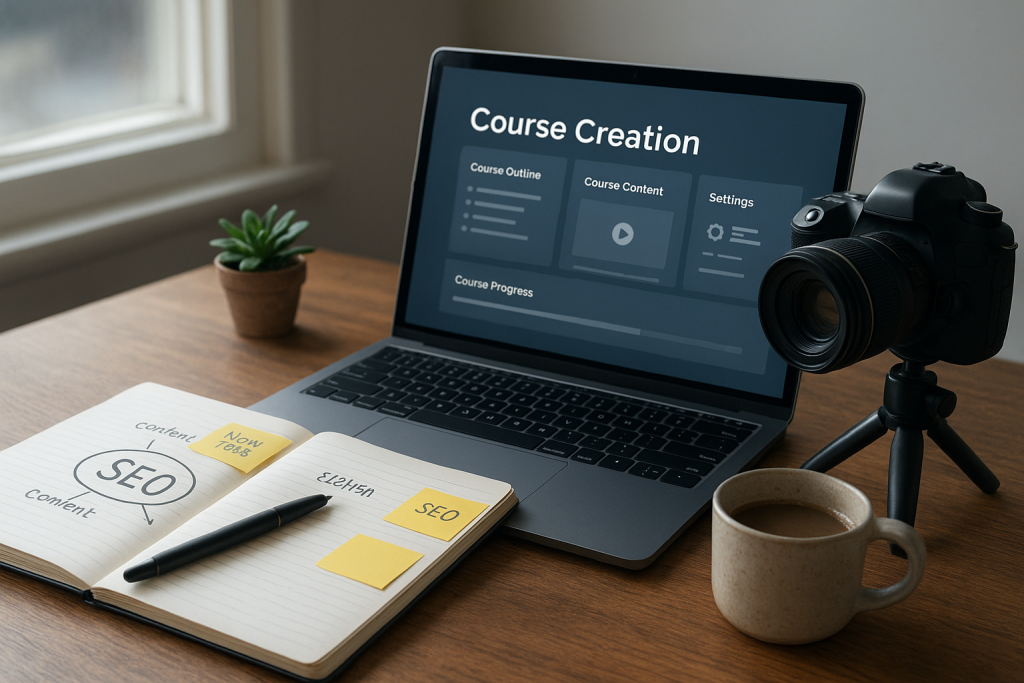
Why online course creation matters for creatives and what to expect
If you’re a musician, illustrator, photographer, or any creative who teaches, sells services, or wants steady income without trading every hour for dollars, creating an online course is one of the smartest moves you can make. It lets you turn expertise you already have into a product that works for you 24/7. But it’s not magic: to build reliable passive income, you need a course that solves a clear problem and a way for that course to be found — and that’s where SEO and systems come in.
Expect this process to combine two parallel efforts. First, you’ll craft a course that actually teaches people to get a result they care about. Second, you’ll make that course discoverable and evergreen by using search-friendly content, repeatable funnels, and automation so the business runs with minimal ongoing effort. For creatives who hate relentless social chasing, this approach trades loud short-term hype for quiet, sustainable visibility: a well-optimized sales page and content ecosystem that attracts the right learners, month after month.
Think of course creation as product design plus discoverability engineering. You design for your ideal student and engineer for the places they search — search engines, YouTube, podcasts, and long-tail blog queries. When those two pieces align, you build passive income and more control over your schedule.
Prerequisites, tools, and outcomes: what you need before you start
Start with clarity about who you serve and what outcome you promise. Your ideal student could be a stage teacher who wants to convert in-person pupils into online students, a hobbyist who wants to level up, or a fellow creative who needs systems to stop reacting and start earning. Write a one-sentence value promise: “I help [audience] do [result] in [timeframe or format].” This will shape everything from module titles to SEO keywords.
Tools you’ll need are simple and affordable. A decent microphone and screen-recording setup are non-negotiable if you’ll lecture or demo. For video editing, tools range from simple (iMovie, CapCut) to more advanced (DaVinci Resolve). Host your course on a platform that fits your technical comfort and goals: some creators prefer all-in-one course platforms with built-in sales pages and student communities, while others prefer separating hosting (like Vimeo or an LMS) from their website for SEO control. A website you own is essential for SEO: that’s where you’ll publish the long-form content and sales copy that search engines index.
Plan outcomes in tangible terms. Define what success looks like for you and the student: revenue targets, monthly student enrollments, completion rates, or time freed. For creatives focused on lifestyle, a realistic outcome might be “replace two monthly in-person clients with an evergreen course that brings $1,000/month in net revenue.” Keep that figure visible while you build — it helps prioritize features and marketing.
Finally, assemble a short checklist: niche and promise, course outline, recording kit, hosting choice, email service provider, simple sales page, and at least three SEO-friendly content pieces (a blog post, a YouTube video, and a resource page) that point to your course.
Validate your idea with keyword research and audience-first testing
Validation keeps you from building something nobody buys. Start by combining two tests: conversational validation with real people, and keyword validation to see if search demand exists.
For conversational validation, ask current students, mailing list subscribers, social followers, or people in your local network what they struggle with. Offer a short survey and a discovery call. Ask what outcome they want, how urgently they want it, and what they’d pay. Creatives often assume their ideas are obvious — don’t. Ask until you find a repeatable problem expressed in their words; you’ll use those exact words in page titles and metadata for better SEO alignment.
Keyword validation is the complementary, technical side. Use a keyword tool to find phrases people search for that match the problem you solve: “how to teach piano online,” “recording vocals at home,” “sell art prints online,” or long-tail, how-to phrases like “convert studio students to online lessons.” Aim for a mix: a few higher-volume, competitive keywords and many long-tail phrases that show intent. These long-tail queries become the backbone of your content strategy — blog posts, video topics, and FAQ sections that will funnel organic traffic to your course.
Combine both signals. If several people describe the same pain point AND you see consistent search phrases for it, you have a validated idea. If the conversations say it’s urgent but search volume is tiny, experiment with a small paid ad or organic social pilot to test real willingness to buy before building a full course.
Real-world example: a music teacher who offers private lessons hears several pupils ask how to practice practice efficiently between lessons. That phrase, “how to practice piano effectively,” may have steady search volume and makes a tight course promise. The teacher builds a short pilot, sells a handful of seats, and uses those buyers’ feedback to refine the full course.
Step-by-step course creation: outline, record, edit, and publish
Building your course is a sequence: outline, draft, record, edit, publish. Take it step by step and don’t let perfectionism stall you.
Outline: Start with the result and reverse-engineer the learning path. What must a student know and do at each stage to achieve the final outcome? Break that into modules and then into lessons. Keep lessons short and focused — 5 to 15 minutes for video lessons keeps attention high. Each lesson should have one clear takeaway and one simple action the student can do to practice that skill.
Draft: For each lesson, write a concise script or talking points. Scripts help you stay clear and reduce editing time. Include examples and a quick real-world task that reinforces the concept. If you’re a musician or teacher, demonstrations and screen capture of sheet music or DAW workflows add clarity and authority.
Record: Choose a quiet space and use a decent microphone and good lighting. Frame your camera so it feels personal — not too distant. For screencasts, record at 1080p and use a consistent template for slides or visuals. Don’t agonize over small mistakes; most proofs can be edited out. Record in sections to avoid fatigue.
Edit: Keep edits tight. Remove long pauses and repetitive phrasing. Add captions — they’re essential for accessibility and improved watch-time. If you’re not comfortable editing, hire a freelancer for a few hours; it’s often worth the cost to lift production quality.
Publish: Create a compelling sales page that leads with the result, addresses objections, and includes social proof — testimonials or case studies. Your sales page should also include clear module outlines and pricing options. Publish the course to your chosen host and integrate payment and student onboarding (welcome email, course access instructions).
Throughout these steps, keep the SEO mindset: craft lesson titles and module names that mirror search language when appropriate, and plan at least three pieces of supporting content that target related queries and link to the sales page.
SEO-driven launch and evergreen distribution: on-page SEO, content funnels, and technical signals
Launching a course is part product launch, part content distribution. For a course to be discoverable without constant ad spend, you must build an SEO-friendly presence around it.
Start with your sales page: use a clear, keyword-focused title and URL. The title should combine your promise with a search-friendly term (for example: “Online Piano Practice Course — How to Practice Piano Effectively”). Use the target phrase in the H1, meta description, and at least a few natural occurrences in the first 200 words. But never stuff keywords — write for readers first, searchers second.
Next, build supportive content that answers the questions your ideal students are typing into search engines. If your course solves a specific problem, create long-form blog posts that teach parts of the solution and link to the course as the complete path. Pair each blog post with a short YouTube tutorial or a podcast episode that targets the same query; video is a powerful SEO signal and often surfaces in search results for how-to queries.
Don’t ignore technical SEO. Fast page speed, mobile responsiveness, and secure hosting are basic hygiene that influence rankings and conversion. Structured data (schema) for courses and reviews helps search engines display rich results — think star ratings or course snippets — which increase clicks.
For launch mechanics, combine a short promotional window with an evergreen plan. A launch sequence creates urgency and initial traction from your email list and close followers; after that, your content pipeline and SEO should carry ongoing sales. Keep in mind that ad-based funnels are valuable but can become more expensive and less reliable over time due to tracking changes and platform shifts; evergreen, search-optimized content gives you a more resilient foundation. (See discussions from other course creators about funnel performance changes in recent years.)
Finally, treat your course site as an ecosystem. Internally link blog content to the sales page, add FAQ sections that pick up common search phrases, and update content periodically to keep it fresh for search engines.
Systems for passive income: email funnels, automation, templates, and alternative monetization
A course becomes passive when systems are in place to attract, convert, and retain students without daily manual effort.
Email funnels are the backbone. Start with a free lead magnet — a short checklist, a mini-lesson, or an SEO cheatsheet tailored to creatives — that solves a tiny urgent problem and collects an email. Use a short welcome sequence to deliver value, build trust, and then invite the subscriber to a low-friction offer like a mini-course or the main course with a time-limited bonus. Evergreen sequences (behaviorally triggered emails based on clicks or module completion) help re-engage students and nudge fence-sitters.
Automation tools let you offload repetitive tasks: automated onboarding emails, drip-release lesson schedules, and tagging in your CRM for follow-up sequences. Templates are powerful for creatives — you can sell or bundle teaching templates, lesson plans, or resource packs as lower-priced products alongside the main course. These templates appeal to busy teachers who want immediate structure and also serve as entry-level offers for your funnel.
Diversify monetization. Besides full-price course sales, consider tiered access (self-study vs. cohort-based), micro-products (worksheets, templates), or licensing to other teachers. Some creatives also license course modules to schools or studios, creating B2B revenue. Pricing should reflect the outcome; transformational, career-level courses command higher prices, while entry-level, skill-focused workshops sit lower on the funnel and attract a broader audience.
To keep things sustainable, automate revenue reporting and schedule a monthly review. Look at enrollments, refund rates, student engagement, and conversion rates from each content piece. Small iterative improvements to funnels and course content compound into meaningful revenue growth without burning you out.
Troubleshooting common problems, measuring success, and next steps for scaling
Problems will come up. Here’s how to handle the most common ones.
If enrollments are low despite traffic, diagnose the conversion path. Are visitors bouncing from your sales page? Check page speed, headline clarity, and whether the value promise is obvious within three seconds. If visitors read the page but don’t buy, revisit pricing, social proof, and risk-reduction elements (money-back guarantee, trial access).
If traffic is low, audit your content strategy. Do your blog posts and videos target real search queries? Are you using long-tail phrases that mirror the way people actually ask questions? If not, refocus on helpful, specific content and answer questions thoroughly. Update older posts with fresh examples and internal links to the course.
If students drop out or give poor feedback, look at engagement: are lessons too long, too jargon-heavy, or lacking practical tasks? Add micro-assignments, short quizzes, and a clear path to quick wins. Consider adding a private community or periodic live Q&A for higher-tier students to increase completion and satisfaction.
Measure success with a few clear KPIs: organic traffic to the sales page, conversion rate (visitor to buyer), monthly recurring revenue from course sales, and student completion/CSAT scores. Use a simple dashboard — you don’t need fancy analytics to spot major trends. A monthly review will keep you focused on what matters and help you iterate effectively.
Next steps for scaling include refining your SEO content cluster (more supporting posts and videos), running partnership promotions with other creatives, and testing paid channels for predictable traffic. If you’re ready to scale faster, cohort-based launches with live elements can increase price and perceived value, but they require more active time; weigh that against your lifestyle goals.
A few final practical tips: reuse content — turn a lesson into a blog post, turn a blog post into a short video, and turn Q&A highlights into FAQs. Keep a clear folder of student testimonials and permission to use them. And most importantly, be patient: organic growth compounds slowly but reliably, especially when your content genuinely helps creative entrepreneurs find the result they want.
—
Creating an online course is a creative act that pays back in time and freedom if you pair excellent teaching with searchability and systems. Start small, validate early, optimize your sales and content for the phrases people actually search, and build automation that does the heavy lifting. For creatives who want to step away from hustle and toward sustainable income, combining thoughtful course design with SEO and reliable funnels creates a real, long-term engine for passive revenue. Take the first step today: pick one problem your students repeat, write a single helpful lesson about it, publish it on your site, and watch what the combination of teaching and discoverability can do.