
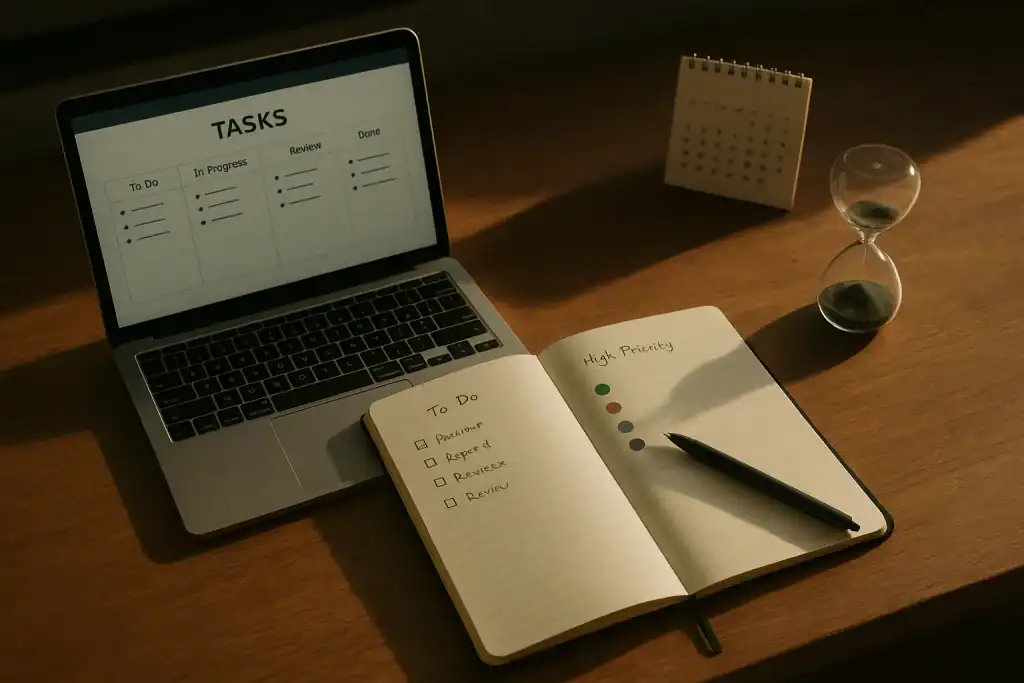
Why choice of routine matters for creative entrepreneurs
You make your living with ideas, not spreadsheets. That means your attention is the most valuable business asset you have. The routines you choose determine whether your day is dominated by client fire drills or shaped around the kind of deep, inspired work that produces courses, templates, blog posts, and music that actually sell. Pick a routine that fits your creative rhythm and lifestyle, and you free up the time to build passive revenue, invest in SEO content that attracts students, and avoid the burnout that comes from perpetual hustle. Pick the wrong one, and you’ll keep trading your creative hours for one-off client payments, never scaling or enjoying the freedom you set out to build.
Two simple scheduling approaches—task batching and time blocking—offer very different tradeoffs. Both can dramatically improve focus and productivity, but the right choice depends on your business model, client rhythms, and the kinds of output you need. This article gives you a practical framework to compare them, real-world examples for creative entrepreneurs, and a 30-day experiment to test which one boosts both your focus and your freedom.
Evaluation framework: criteria for comparing task batching vs time blocking
To make this comparison useful, we’ll evaluate both approaches across three core criteria that matter most to creative business owners: how well they support focus and flow, how they align with lifestyle and scale, and how they affect revenue-generating activities such as client work and SEO-driven content creation.
Focus, flow, and cognitive cost
Creative work thrives on long, uninterrupted focus. But attention is finite; switching cost between tasks — the time your brain needs to refocus — can erode hours every day. When we judge task batching and time blocking, ask: which method reduces context switching and helps you enter flow sooner? Also consider the cognitive fatigue each approach produces. For example, constant micro-batching of many small admin tasks may feel efficient but can fragment your day. Conversely, long blocks of deep creative time may yield breakthrough work but leave urgent client items piling up.
Flexibility, scalability, and lifestyle alignment
Your scheduling choice must match the lifestyle you want. If you’re building passive products—courses, templates, or SEO-rich blog posts—you need predictable, dedicated creation time. If your business is service-heavy with calls and last-minute client requests, you need flexibility to respond without derailing your whole week. Think about scale: does your routine allow you to swap one hour of client time for another that produces a scalable asset? Does it let you preserve a weekly rhythm so you can batch record lessons or write multiple SEO posts in one run?
Client-facing demands, revenue impact, and SEO/content output
Not all hours are equal. A coaching call that bills at $150/hr is different from an hour that yields a small SEO post that, over six months, brings evergreen traffic and passive sales. Evaluate routines by how they protect high-leverage activities. Which method frees blocks to create long-form content, record courses, or produce YouTube videos that feed your funnel and grow organic visibility? Which method helps you maintain the day-to-day responsiveness that keeps clients happy and referrals flowing?
How task batching works in practice for creatives
Task batching groups similar tasks together and handles them in dedicated sessions. Instead of slicing your morning into a dozen different actions, you allocate a block to a type of task—email processing, content editing, outreach, or bookkeeping—and do all of those items back-to-back.
Typical batch types (content, admin, outreach) and real-world examples
A typical creative entrepreneur might run batches like these: a two-hour content batch to record and edit three short tutorials; a one-hour admin batch to clear invoices, update project trackers, and tag files; a 90-minute outreach batch to reply to collaboration requests, schedule social posts, and send follow-up emails. One real-world example: a composer who bundles every week’s score-mixing tasks into a single afternoon, so they can spend two other mornings recording new sample packs. Another: an online teacher who records four micro-lessons in one session, edits them immediately, and drafts the accompanying SEO-optimized lesson pages while the ideas are fresh.
Task batching shines where tasks share a cognitive posture. When you dedicate a session to the same mental context, you reduce the friction of switching mental gears and often move faster than you would doing the same tasks piecemeal throughout the day.
Strengths, weaknesses, and ideal use cases
Task batching’s primary strength is efficiency. It compresses the time overhead of context-switching and can lead to surprising productivity gains for recurring tasks. It also maps well to content creation workflows: once you’re in the zone for recording, you can batch multiple lessons, thumbnails, or blog drafts.
Weaknesses arise when urgent interruptions are common or when your business requires constant client touchpoints. If you block off a three-hour batch and a client needs a quick change, you either break the batch or risk client dissatisfaction. Batches also require discipline to keep small tasks from ballooning into scope creep—what’s supposed to be a 30-minute email batch can become a two-hour “reply vortex” if you let it.
Ideal use cases for batching include producing libraryable assets (recordings, templates, blog series), weekly administrative cleanup, and marketing outreach that benefits from continuity (e.g., a follow-up campaign sent in one sitting). If you’re building passive offerings and SEO content—exactly what creative entrepreneurs aiming for lifestyle-aligned business models need—task batching makes it easier to create consistent, repeatable outputs.
How time blocking works in practice for creatives
Time blocking assigns parts of your calendar to specific activities with strict start and end times—deep work from 9–11, meetings from 1–3, admin from 3–4. Unlike batching (which groups tasks by type and may be scheduled flexibly), time blocking prescribes when kinds of work happen and protects those times on your calendar.
Block structures (deep work, day theming, calendar protection) with examples
There are multiple blocking styles. You might use daily deep-work blocks dedicated to songwriting or course recording, sandwiching shorter blocks for client calls. Or you might theme entire days—“Content Tuesdays” and “Client Fridays”—so your calendar supports large-scale production. A freelance videographer could block Monday and Tuesday mornings for editing with meeting slots in the afternoons. A creative coach might protect two daily deep-work slots for program development and market research while keeping one flexible slot for live client sessions.
Time blocking’s discipline shines when your calendar is cluttered with obligations. By protecting time ahead of the week, you force prioritization: if a client asks for work during a blocked slot, you negotiate the exception rather than let tasks slide your creative time away.
Strengths, weaknesses, and ideal use cases
The power of time blocking is predictability. When you treat creative hours like appointments, you’re less likely to let them vanish under admin overload. Time blocking supports deep work and long-form projects that require sustained attention, which is excellent for course creation, long podcasts, and comprehensive SEO campaigns.
Its weaknesses are rigidity and sometimes unrealistic expectations. Highly unpredictable client work can make rigid blocks feel impractical. If you over-block, you might experience guilt or constant rescheduling, which defeats the purpose. Time blocking also requires you to estimate work durations well; underestimating can cascade into missed deadlines.
Time blocking is ideal for creatives who can carve reliable windows for studio work or content creation, and for entrepreneurs seeking the discipline to protect high-leverage hours that produce long-term organic growth—like writing SEO-rich articles, recording a course series, or editing video batches.
Hybrid strategies, tools, and AI-assisted workflows that combine batching and blocking
You don’t have to choose a side. The most practical systems often blend both: use time blocking to protect the hours, and then fill those blocks with focused task batches.
Practical hybrids (blocks that host batches) and scheduling templates
A common hybrid is weekly day theming with intra-day batching. For example, block Tuesday and Thursday as “creation days” on your calendar. Within those blocks, batch specific tasks: the morning for recording three videos, the afternoon for editing two and writing the associated SEO-optimized lesson pages. Another template: reserve 90-minute deep-work blocks three times per week, and in each block, complete a defined batch (outline, record, edit). This structure gives you the flexibility of batching with the psychological protection of a blocked calendar.
This hybrid approach works well for Tonya Lawson–style entrepreneurs who are moving away from hustle culture toward sustainable business models: you get repeatable systems for producing passive products while preserving family time and creative flow. You can schedule automation setup and SEO work in predictable windows, then spend other protected blocks on client coaching or outreach.
Tools, automations, and AI prompts to save time and scale output
Use scheduling tools (calendar apps with color-coding), task managers with tagging (so batches are easy to filter), and simple automations to reduce context-switching. For example, turn on an autoresponder during deep-work blocks to reduce interruptions. Use AI to accelerate repetitive steps—AI drafts for lesson outlines, caption generation for videos, or email sequence templates—so your batches focus on high-value creative decisions, not rote work.
Helpful tools include calendar integrations that show “busy” blocks, task managers that allow batch tags, and lightweight automations that create content skeletons. The goal is to make your batches predictable and your blocks sacred: automate what you can, batch what’s similar, and block the rest.
Implementation considerations, common pitfalls, and how to test what fits you
Start small and measure. Radical scheduling overhauls often fail because they ignore the real rhythms of your clients and life.
Small experiments, measurement (time audits, conversion to course sales), and iteration
Run short experiments to find the right balance. A two-week test of pure batching will reveal if client interruptions derail you; a second two-week test of time blocking will show whether rigid blocks are sustainable. Track simple metrics: number of uninterrupted creative hours per week, the number of pieces of content produced, and business outcomes like leads or course sales. If your goal is more SEO traffic and course conversions (as many creative entrepreneurs aim for), measure content output and subsequent traffic or signups over 30–90 days to see which routine supports consistent content creation.
A practical approach is a time audit in week one—log how you spend your hours—to identify where context switching steals time. Then implement the chosen experiment and compare. The data you gather will tell you which method preserves creative time and produces measurable outcomes.
Managing client needs, interruptions, and burnout risks
Both systems need guardrails for interruptions. Set expectations with clients by publishing availability windows and using clear response timelines. For urgent requests, have a triage system—e.g., a short daily check-in batch so nothing truly urgent slips. Avoid the trap of over-scheduling: creative work needs recovery and room for unplanned inspiration. Make sure your routine includes buffer time and days off to protect long-term creativity and well-being.
If you feel burnout creeping in, scale back. Reduce your blocked hours or shorten batches, and reintroduce them slowly. The goal is sustainable output, not maximum output.
Decision guide: which method to choose based on specific creative-business scenarios
Not every creative entrepreneur benefits the same way. Here are two scenario-based recommendations to help you decide.
Solo creatives building passive products and SEO-driven content
If you’re focused on building courses, templates, or a content library that feeds organic traffic and passive sales, favor a hybrid leaning toward time blocking. Protect longer, predictable deep-work blocks for content creation and course production. Inside those protected blocks, batch similar production tasks—outline, record, edit—so you produce multiple deliverables in a single creative stretch. This approach aligns with Tonya Lawson’s advice to prioritize SEO-friendly content and repeatable systems: you’ll produce the sustained, high-quality content that attracts students and converts them into buyers.
Implementation tip: Theme two full days per week as “content days,” use AI to draft initial outlines, and batch record multiple lessons in one session. Measure output vs. organic traffic and iterate monthly.
Service-based entrepreneurs with client calls and deadlines
If most of your income comes from coaching sessions, client work, or ad-hoc projects, task batching will likely feel more natural. Batch similar tasks—client replies, proposal writing, project checklists—into predictable sessions so you can respond quickly while preventing emails and small tasks from eating your creative hours. Time block your calendar for client meetings but keep at least one daily small batch for admin to reduce constant reactive work.
Implementation tip: Reserve mornings for client-facing calls and use late afternoons for a 60–90 minute admin batch. Reserve two weekly deep-work blocks for product development so your service business can gradually produce scalable offerings.
Next steps: a 30-day plan to test task batching vs time blocking and scale what works
Ready to try both? Here’s a simple 30-day roadmap that helps you test, measure, and pick the system that grows your creative business without sacrificing your life.
Week 1 — Audit and plan: Log your current week to see where time leaks happen. Decide which two-week method you’ll test first and communicate your availability to clients. Identify one high-leverage project (a mini-course, a four-part blog series, or a pack of templates) as your test output.
Weeks 2–3 — Run experiment A (Task Batching): Schedule three defined batches per day—content, admin, outreach—keeping blocks relatively short (60–120 minutes). Track uninterrupted creative hours, items completed, and any client issues. Note subjective measures: energy, flow, and stress.
Weeks 4–5 — Run experiment B (Time Blocking): Protect two daily deep-work blocks and theme two days for content. Inside the blocks, batch production tasks. Again measure output, interruptions, and business outcomes like leads or product progress.
Final week — Analyze and decide: Compare the data. Which method produced more focused, high-quality output? Which felt sustainable? Which led to progress on your high-leverage project? Use those findings to build a hybrid routine—perhaps time blocking for weekly creation days and batching for the rest.
Conclusion
Both task batching and time blocking are powerful tools for creative entrepreneurs—but neither is a silver bullet. Batching increases efficiency by reducing context switching; time blocking protects creative time by making it sacrosanct on your calendar. The best approach for sustainable growth and freedom is usually a hybrid: use time blocks to protect your highest-leverage hours, and fill those blocks with targeted batches to crank out consistent, SEO-friendly content and scalable products.
You’re building more than a business—you’re designing a life. Treat your calendar and task system like a design problem: test, iterate, measure, and adjust. Protect your deep work. Automate the low-value bits. And give yourself permission to prioritize the creative projects that scale the business and your freedom. After thirty days of intentional scheduling, you’ll know which method helps you produce the work that matters most—and keeps you excited to create again tomorrow.
Table: Quick comparison at a glance
Now pick one small experiment, protect one daily creative hour, and start. The rest you’ll figure out as you go—one batch, one block, one creation day at a time.