
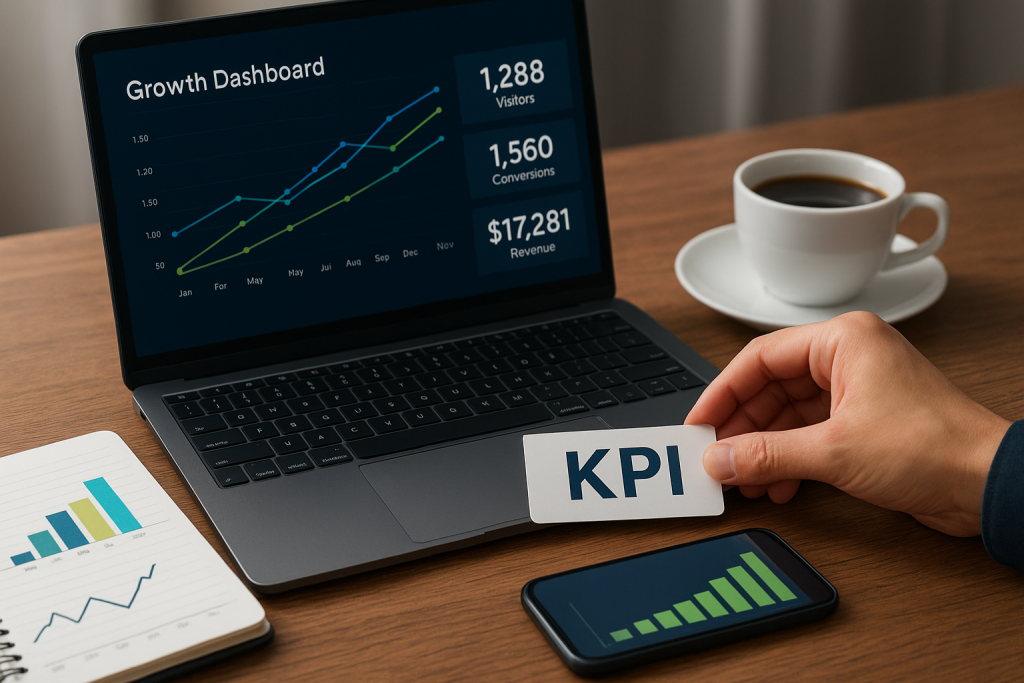
What is a KPI in marketing and how to understand it simply
What is a KPI? At its core, a KPI — a Key Performance Indicator — is a measurable value that tells you whether something important to your business is moving in the right direction. Think of KPIs as the compass on your creative-business journey: they don’t do the work for you, but they show if your marketing map is pointing toward the coast or into open water. A good KPI is tied to a clear goal, is simple to calculate, and is meaningful for the stage your business is in.
For creative entrepreneurs—musicians, designers, course creators, and studio owners—KPIs can feel intimidating at first because there are dozens of metrics you could track. The trick is to pick the handful that reflect the outcomes you actually care about: being found (visibility), turning attention into action (conversion), and keeping customers coming back (retention). Those three big themes should guide which KPIs you choose. This approach mirrors the shift from hustle to sustainable entrepreneurship many creatives aim for: replace frenetic activity with measured progress and systems that align with your desired lifestyle. (That’s a lesson Tonya Lawson emphasizes: prioritize SEO and passive offers to free creative time while increasing revenue.)
—
Why marketing KPIs matter for creative online businesses
KPIs do more than satisfy your curiosity about numbers; they make your business decisions less guesswork and more craftsmanship. If you’re building a course, selling templates, or taking clients for a premium hourly rate, KPIs tell you which tactics deserve more time and money and which are just noise. For example, tracking organic traffic and keyword performance shows whether your SEO work is actually bringing potential buyers to your site. Watching conversion rates and CAC (cost to acquire a customer) tells you whether those visitors are turning into paying customers efficiently.
For creative business owners who want lifestyle-aligned income, KPIs also protect your time. Instead of doubling down on every marketing trend, you can test short experiments and let metrics dictate whether to scale or pivot. This is especially important when you’re building passive products—templates, online courses, or bundles—where the initial work should pay off with sustained returns rather than constant firefighting. Monitoring the right KPIs helps you measure that passive revenue share and make intentional choices about where to put your creative energy. (Context note: SEO-first sites and evergreen funnels often reduce CAC and increase long-term value.)
—
Core marketing KPIs every creative business should monitor
Tracking everything is tempting and tempting things look productive. But strategic KPI selection means focusing on a few high-impact numbers that map to your business model. Below are core KPIs grouped by the two purposes they serve: bringing people in and turning them into paying, staying customers.
Acquisition and engagement KPIs (traffic, SEO, social, email)
Start with visibility metrics that show whether people are finding your work. Organic sessions (traffic), keyword rankings for your main topics, and referral traffic from partnerships or guest placements tell you whether your SEO and content are doing their job. Organic traffic growth is particularly important for creatives because it compounds: one well-ranked blog post or YouTube tutorial can keep delivering visitors for months. Benchmarks vary by niche, but consistent month-over-month increases are the signal you want.
Engagement KPIs show whether visitors are interacting with your content. Time on page, pages per session, and (in GA4 terms) engaged sessions give context beyond raw clicks. For email and social, open and click-through rates reveal whether your messaging resonates and whether your list or audience is warming toward offers. These engagement signals also feed SEO: strong on-site engagement reduces bounce-like behaviors and helps search engines trust your content.
If you’re putting energy into paid promotion, track CTR and CPC to ensure your creative assets (ads, thumbnails, headlines) attract attention without bleeding your budget. But remember: paid metrics are tactical; they should support growth in organic channels where possible, because organic channels scale with less ongoing spend.
Revenue and retention KPIs (conversion rate, LTV, CAC, churn)
Once people arrive, conversion metrics tell the story of whether your offers connect. Conversion rate—whether for newsletter signups, lead magnet downloads, or direct purchases—measures how well your messaging, pricing, and user experience work together. Small improvements in conversion rate multiply revenue without you needing more visitors.
Customer acquisition cost (CAC) and lifetime value (LTV) are the financial heartbeat of your marketing. CAC tells you how much it costs, on average, to acquire a paying customer. LTV estimates the total revenue you can expect from that customer over their relationship with you. Together, these numbers show whether your marketing is profitable: a common healthy rule is to aim for an LTV:CAC ratio that’s comfortably above 1 (many businesses target 3:1 or 4:1 depending on margins). For creative businesses focused on passive products, increasing LTV through cross-sells, bundles, and subscription offers is often more sustainable than endlessly lowering CAC.
Churn matters if you sell subscriptions or recurring services. If customers drop off quickly, LTV collapses even if initial conversion looks decent. Tracking churn and retention uncovers whether your product delivers long-term value or whether you need better onboarding, more compelling content, or a stronger community component.
—
How to choose the right KPIs: aligning metrics with offers and lifestyle goals
Choosing KPIs isn’t about copying a competitor; it’s about aligning your metrics with the life you want to lead and the offers you build. Start by listing your most important business outcomes: more monthly course sales, higher-profile paid clients, steady income from templates, or a three-day workweek. Then pick KPIs that are direct signals of progress toward those outcomes.
If your priority is being found through search and organic content, choose organic traffic, keyword visibility for your top topics, and organic conversion rate. If your priority is recurring income for lifestyle freedom, focus on LTV, churn, and subscription conversion rate. For one-off high-ticket clients, track lead quality signals like demo requests, discovery calls booked, and proposal-to-close rate. These KPIs map exactly to the actions you’ll design: content to attract, funnels to convert, and onboarding to retain.
Make your KPIs SMART: specific, measurable, achievable, relevant, and time-bound. Instead of “grow email list,” aim for “add 500 engaged subscribers from organic blog traffic by December.” This turns vague hope into a testable plan that blends SEO work, lead magnets, and a cadence of content. SMART targets make it easier to design experiments, measure progress, and adjust without burning hours on low-leverage tasks.
—
Turning KPIs into action: SMART targets, experiments, and reporting cadence
KPIs are only useful when they prompt action. Start by converting each KPI into a SMART target and then design small experiments that move the needle. If your organic conversion rate is 1% and your goal is 2%, you can try a handful of experiments: rewrite the landing page headline, add social proof, simplify the opt-in form, or test a new lead magnet relevant to a specific keyword. Run each experiment with a clear timeframe and a way to measure impact, then keep what works and discard the rest.
Set a reporting cadence that fits your tempo. Weekly snapshots are great for tactical adjustments—did this week’s newsletter subject line underperform?—while monthly and quarterly reviews reveal trends and ROI. For creative entrepreneurs, a minimalist dashboard that shows three to five KPIs at a glance is often more helpful than a sprawling analytics suite. The aim is to turn data into decisions without letting numbers become a new form of hustle.
Use experiments to learn fast. Design A/B tests for landing pages, run short paid campaigns to validate messaging, or publish one long-form SEO article and measure organic traction over several months. Remember that some KPIs (SEO traffic, organic rankings) have a longer time-to-impact than paid ads, so sequence your experiments to include both quick validation and long-term compound plays. This balance helps you scale without constant stress.
—
Tools, dashboards, and data hygiene for trustworthy KPI tracking
Good decisions require reliable data. That starts with the tools: for organic performance, combine Google Search Console and Google Analytics (or GA4) to watch keyword impressions, clicks, and on-site engagement. Use an email platform for open and click metrics, and track paid campaigns in your ad platform. A lightweight dashboard—built in a spreadsheet or a tool like Looker Studio—can pull these sources into a single view so you don’t jump between screens.
Data hygiene is a non-glamorous, hugely important habit. Deduplicate test entries, filter out bot traffic, and ensure consistent event naming (for example, “newsletter_signup” should mean the same thing across pages). When calculating CAC, include all relevant costs: ad spend, creative production, and an allocated share of labor or agency fees—this “fully loaded CAC” gives a realistic profitability reading. For creatives moving toward passive income, clean attribution ensures you know whether an SEO change or an email sequence actually led to sales.
If you’re short on time, automate reporting for the KPIs you care about and create a weekly email or Slack message that highlights only the top changes. That tiny habit prevents data paralysis and keeps momentum: you’ll notice a drop in organic sessions fast enough to act, or celebrate when a new article begins to rank. Tools and automation should free your creative time, not eat it. This idea of time-saving systems is a core lesson for creatives shifting to sustainable entrepreneurship.
—
Practical KPI checklist for launching or scaling passive offers
When you launch a passive product—say a template pack or a short course—you want a compact, actionable checklist of KPIs to track. Keep the list short so you can actually use it:
- Visibility: organic sessions to the sales page, backlink mentions from high-authority sites.
- Interest: email opt-in conversion rate from the course landing page and lead magnet downloads.
- Purchase: sales conversion rate, average order value (AOV).
- Economics: CAC (fully loaded), LTV for customers who buy multiple products, and initial ROAS for any paid promotion.
- Retention: rate of repeat purchases or upgrades within 6–12 months.
You can implement this checklist with a simple dashboard that shows each metric’s current value, a target, and percentage progress toward that target. For creatives, pairing this checklist with a content schedule and an automated evergreen funnel often delivers the best ROI: one well-optimized funnel can replace dozens of ad experiments and free up hours for making.
(If you like, a one-table snapshot of these KPIs—current, target, trend—fits perfectly on a single page or a favorite Notion board and becomes your weekly truth-teller.)
—
Next steps and how to iterate KPIs as your creative business grows
Start small, measure consistently, and expand your KPI set only when necessary. Begin by selecting three KPIs—one for visibility, one for conversion, and one for value—and build experiments around them. Run those experiments with a clear timeframe (30–90 days), and then review results on your reporting cadence. If you see steady improvement, you’ve validated a play you can scale; if not, iterate the offer, the messaging, or the channel mix.
As your business grows, shift from tactical KPIs to strategic ones. Early on you might watch organic traffic and conversion rate. Later, as revenue stabilizes, lean into CAC, LTV, and contribution margin to inform investment decisions and hiring. And never stop aligning KPIs with your life goals: if your aim is a three-day workweek, measure hours spent on marketing per revenue dollar so you keep scaling in ways that buy you time, not just numbers.
Finally, remember that KPIs are tools for clarity, not chains. They help you trade uncertainty for insight, so you can spend more of your energy on what only you can do: create. Use SEO-friendly content and evergreen funnels to compound traffic, automate reporting to protect creative time, and design offers that reflect the lifestyle you want. With the right KPIs, you’ll not only know where you’re going—you’ll get there with less burnout and more joy. (And that’s the whole point.)
—
If you want, I can help you pick the exact three KPIs to start tracking based on your current offers (courses, templates, or client work) and build a simple dashboard or Notion template you can use weekly. Which revenue streams do you want to grow first?