
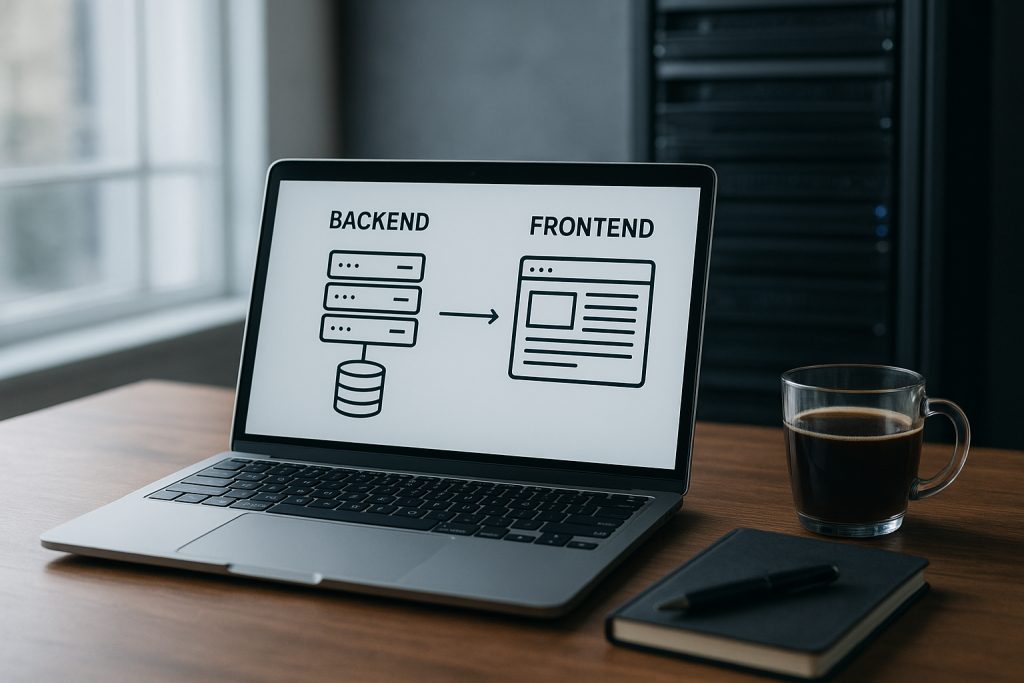
What ‘back-end’ means in business and how it differs from ‘front-end’
When people talk about back-end in business they usually mean everything that happens behind the scenes to make a product or service work — the systems, processes, and offers customers rarely see until after the sale. Think of the front-end as the handshake: the website, the ad, the freebie, the first lesson. The back-end is the conversation that follows: premium courses, subscription access, coaching packages, add-ons, operations, fulfillment, and the internal systems that keep all of that running. This split — customer-facing versus behind-the-scenes — is useful because it helps you design two complementary parts of a business where each plays a different role in growth and profitability.
That distinction appears across fields. In software, front-end is what users interact with and back-end is the logic and data that power it; in commerce, front-end drives awareness and trial while the back-end drives lifetime value and margin. The simplest way to remember it: front-end brings people in; back-end turns attention into sustainable income.
Definitions and the customer-facing vs behind-the-scenes distinction
Why back-end systems and offers matter for revenue: the economics of backend sales
Backend sales are where profit density often lives. A low-cost or free front-end offer — a free lesson, a lead magnet, a low-ticket mini-course — lowers acquisition friction and grows your audience. But the back-end is what converts that audience into higher-margin, longer-term customers: multi-month coaching, memberships, bundles, templates, course sequences, and premium services. Businesses that rely solely on front-end transactions typically struggle with churn and tight margins; those that intentionally design a back-end funnel can multiply customer lifetime value (LTV) and make marketing investments pay off over time.
Economically, a strong back-end accomplishes three things. First, it increases average revenue per customer because you’re offering incremental value above the entry point. Second, it improves margins when you package digital or automated products (templates, on-demand courses, or evergreen funnels) that scale without proportional increases in fulfillment cost. Third, it creates sustainability: predictable recurring revenue or repeat purchases reduce pressure to constantly find new customers. For creative entrepreneurs—music teachers, studio owners, and course creators—this is the difference between feast-or-famine income and a dependable business that fits a life you actually want.
How back-end offers increase lifetime value, margins, and sustainability
Front-end vs back-end in practice: examples and real-world use cases for creative businesses
To make this real, let’s walk through a few scenarios that mirror what creative business owners face.
A local music teacher might use a free downloadable practice planner or a one-off low-cost “Get Your First Student” webinar as the front-end. Those touchpoints collect emails and build trust. The back-end could be a tiered system offering monthly private lessons, a prerecorded course on piano technique, a membership with weekly group classes, and downloadable studio-run templates for scheduling and billing. Each back-end product targets different needs: steady income from recurring lessons, leverage from recorded courses, scale from templates. This combination reduces dependence on local advertising and referrals and lets the teacher monetize the same audience in multiple ways.
An independent course creator might run a free YouTube series as the front-end, a low-cost masterclass as the mid-tier, and then offer a high-touch cohort course or one-on-one mentoring as the back-end. The audience who consumed the free content is already warmed; the mid-tier proves the creator’s method; the back-end converts the most committed buyers who want deep results. That ladder—from free to low-ticket to high-ticket—is a classic front-end→back-end flow that many successful creator businesses use.
A productized service example: a studio owner could sell downloadable lesson-plan templates to other teachers (back-end product) while using free blog content or local listings (front-end) to bring traffic. The templates scale, they’re SEO-friendly assets, and they free the owner to spend more time on higher-value coaching or growing an online course. This matches research showing back-end packages often deliver outsized profit when paired with smart discoverability and funnels.
Studio and course examples: free/low-cost front-end leads into backend sales
Designing your back-end strategy: criteria for evaluating backend sales and operations
If you’re thinking about backend sales, treat the design process like product development. Start by evaluating candidate offers along hard criteria: customer fit, perceived value, fulfillment cost, delivery method, and discoverability (especially via SEO).
Customer fit asks whether your back-end solves a meaningful problem for the people who engage with your front-end. Pricing must reflect perceived transformation, not just time spent. Fulfillment cost separates healthy back-end offers from money-draining ones: a one-on-one coaching package might command a high price but also requires exclusive time; a digital template or evergreen course usually costs little to maintain once built. Delivery method matters: live cohorts require scheduling and support, while on-demand products demand initial production effort and a reliable platform and support pathway. Finally, discoverability—how people find the front-end via search, social, or referrals—determines how many prospects enter the funnel in the first place; for creatives, SEO on your website and content can be a low-cost, high-impact channel.
A useful framework is to score potential back-end products on a simple matrix: customer impact (high/medium/low) versus operational cost (high/medium/low). High impact, low cost is ideal (templates, evergreen micro-courses). High impact, high cost can still be worth it when it supports premium pricing and brand positioning (retreats, 1:1 coaching cohorts). Low impact, low cost might be a filler product but often dilutes your brand if relied on too heavily. Use this framework to prioritize what to build first.
Customer fit, pricing, delivery, fulfillment cost, automation, and SEO-driven discoverability
Implementation considerations and common challenges when building backend sales
Creating a profitable back-end is part product strategy, part operations, and part marketing. There are predictable stumbling blocks: underpriced offers, underestimating fulfillment work, poor sequencing between front-end and back-end, and weak discoverability. Addressing these requires both tactical choices and some upfront systems work.
Technical infrastructure. Decide where you’ll host and deliver the back-end: a learning platform (Teachable, Thinkific, Podia), membership software (Memberful, Circle), or your own website with gated content. For creatives prioritizing SEO-driven discoverability, keeping core content and sales pages on your own site usually pays dividends, because it builds domain authority and reduces platform dependency. Integrations matter: email marketing, payment processors, and CRM-like tagging to segment customers are essential to automate cross-sells and follow-ups.
Staffing and back-office processes. Even solopreneurs need dependable processes for customer support, refunds, onboarding, and content updates. If your back-end includes live services, build a scheduling and cancellation policy that protects your time. If you sell digital products, plan for versioning and a simple support flow. Outsourcing small recurring tasks—email sequences, content repurposing, bookkeeping—lets you focus on product quality and growth.
Marketing funnels and sequencing. The front-end should naturally lead toward the back-end. That means the front-end content must build trust and demonstrate a path to deeper results. For example, a free SEO-friendly blog post teaching “how to convert trial students into paying students” might link to a low-cost masterclass, which then promotes a backend coaching program. Each step should justify the next: show a small win first, then offer the deeper transformation.
Maintaining product quality. One risk of scaling back-end offers—particularly templated or low-touch digital products—is a gradual drop in perceived value as your customer base grows. Keep a feedback loop: gather testimonials, monitor support tickets, and periodically update content. That preserves word-of-mouth and reduces refunds. Forbes and product strategy resources note that a strong back-end often becomes a defensible part of your business when it’s regularly improved and aligned with customer outcomes.
Technical infrastructure, staffing/back-office processes, marketing funnels, and maintaining product quality
Recommendations and next steps: choosing the right back-end approach for different creative-business goals
If you’re a creative entrepreneur tired of chasing single sales and last-minute bookings, building a considered back-end is the clearest route to stability. Start by treating your audience as people with layered needs: they want quick wins first, and then real transformation. Use SEO-friendly front-end content to bring them in, then design back-end offers that match their readiness and willingness to pay. Keep the operations simple at first—use available platforms, automate where possible, and outsource repetitive tasks that drain your creative energy.
Remember the three priorities: customer fit, delivery cost, and discoverability. When you align those, your back-end becomes the engine that pays for better marketing, better tools, and more creative freedom. You’ll stop selling time-for-money and start packaging expertise in ways that compound: a template sold once can pay for dozens of hours you reclaim. A membership can replace inconsistent bookings. A cohort course can create both income and a community that elevates your work.
You don’t need to do everything at once. Pick one realistic back-end offer, validate it quickly, and iterate. You’ll learn faster, reduce wasted effort, and build confidence. If you want practical templates, SEO checklists, and step-by-step funnels made for creative teachers and studio owners, the next step is to map one front-end asset to a single back-end offer and test it with your audience—track conversions, ask for feedback, and then expand.
By thinking of your business as a front-end that invites new people and a back-end that creates lasting relationships and revenue, you transform the way you work. It’s not about more hustle. It’s about smarter design: an audience-first front-end and a profit-first back-end that together let you grow without burning out.