
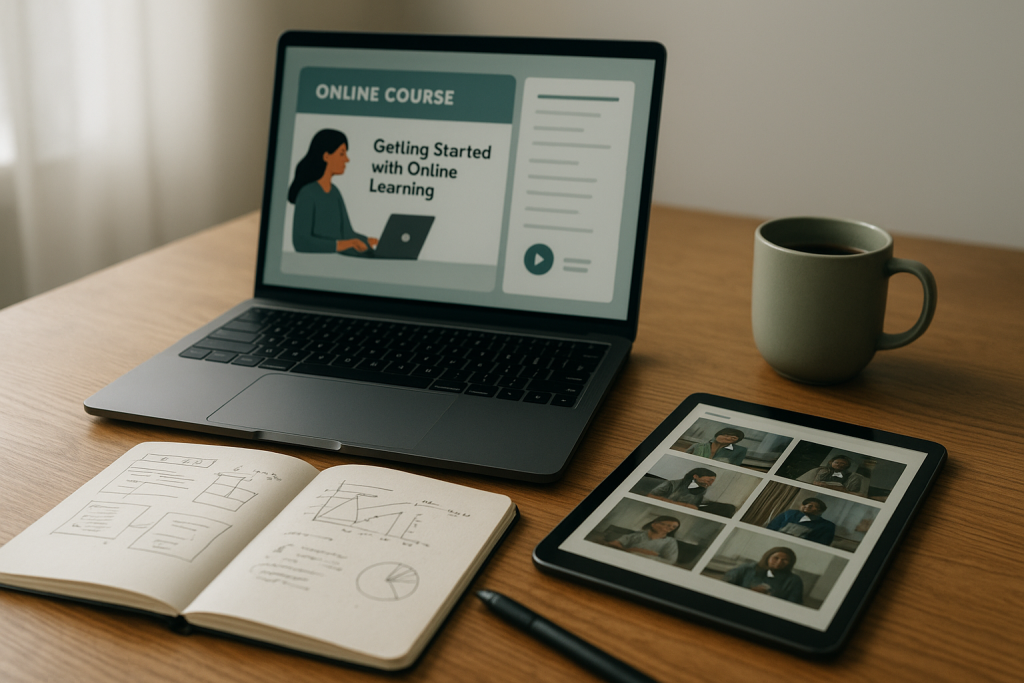
Why creative entrepreneurs should master online course creation
You love teaching. You love creating. But trading every hour for a dollar—teaching one student at a time—puts a hard cap on your income, your energy, and the life you actually want to live. Mastering online course creation is how you break that ceiling. When you package your expertise into a course, you convert repeatable studio knowledge into a product that can sell again and again, and when you pair that product with an SEO-first approach, people can find you without a frantic daily social push.
For creative entrepreneurs—musicians, studio owners, visual artists, and specialty instructors—this shift is both practical and freeing. A well-built course becomes a predictable revenue stream that complements private lessons and gigs. It lets you design offers to match the lifestyle you want: a lean starter course for new students, a pro tier for committed learners, and add-ons like templates or coaching for those who want more. The best part? With focused SEO and a discoverable website, you reach people who are actively searching for what you teach, rather than shouting into a noisy social feed.
Think of an online course as a flagship product: it demonstrates your teaching style, expands your audience, and creates new options—evergreen funnels, memberships, and template shops—that together reduce reliance on gigs. This guide walks you through that journey step by step, from the tools you need to the verification checks that tell you the launch worked.
How diversified, passive income and SEO-first visibility change a creative business
Prerequisites, expected outcomes, and tools you’ll need
Before you record a single lesson, set your expectations and line up basic tools. Your prerequisites are simple: a clear idea of who you teach, a quiet place to record, and 4–8 focused hours to validate the idea. Expected outcomes from following this guide include a validated course concept, a recorded minimum viable course (three to five lessons), a simple sales page, and an automated email welcome funnel.
Tools fall into three buckets: production, delivery, and growth. Production is lightweight: a reliable USB microphone, acoustic treatment (even blankets will do), screen-recording software (for demonstrations), and a basic video editor. Delivery can be as simple as a course platform or a membership plugin on your website; choose what fits your technical comfort and budget. Growth tools lean into systems: a website with SEO basics configured, an email provider that supports automation, and a simple funnel builder. Don’t ignore workflow helpers—calendar apps, task trackers, and AI-assisted drafting tools to speed script outlines and lesson notes.
Include time-management systems from the start. Decide whether you’ll batch-record or teach lesson-by-lesson. Batching saves time and produces consistent quality. Use focused blocks (90 minutes of deep work, 10–15 minute break) to stay creative without burning out. When appropriate, use AI to draft lesson outlines or transcribe audio—it speeds editing and helps you repurpose content without replacing your voice.
Studio, software, course platform, and time-management systems (including AI helpers)
Validate your course idea and map Focus Keywords to audience needs
Validation is where most creators either save themselves weeks of wasted effort or fall into the “build it and hope” trap. Start by mapping what your ideal student searches for—here’s where focus keywords become your friend. A Focus Keywords approach means choosing a few clear phrases that describe the result your student wants, then testing demand for those phrases.
Begin with simple research: talk to current students, ask what they struggle with, and read questions in forums and social groups. Run two very small validation experiments. First, write a short landing page describing a one-module mini-course and link to a sign-up form for an interest list. Second, create a single free mini lesson or checklist and promote it to your audience for a small ad test or an email blast. If people trade their email for your resource and open the first message, you’ve got demand.
Niche matters. You’ll have more traction if you teach a tightly focused skill—”songwriting for beginner singer-songwriters” or “studio workflow for piano teachers”—rather than a generic broad topic. Nicheing makes it easier to pick Focus Keywords that your ideal student actually searches for and makes your course attractive to search engines and human beings alike.
Validation also includes pricing experiments. Offer a beta price to early adopters in exchange for feedback and testimonials. That not only funds production but gives you social proof that boosts conversions later.
Market research, nicheing for creative teachers, and simple validation experiments
Design a sellable course: structure, pricing tiers, and real-world examples
Good course design feels inevitable when a student looks at the curriculum and says, “Yes—this solves my problem.” Start with outcomes: what will students be able to do after finishing? Break that outcome into 4–8 modules that feel like logical progressions rather than disconnected videos. Each module should focus on a single skill or milestone and include a simple deliverable—an assignment, a template, or a short practice recording.
Structure lessons so each one follows a pattern: a quick intro to the objective, a demonstration or story that makes the idea memorable, the step-by-step process, and a micro-assignment that students can finish in 10–30 minutes. That rhythm keeps learners moving and gives you quick wins to celebrate in your sales copy.
Pricing strategy should reflect value and audience. A starter tier might be an affordable self-study course with downloadable templates. A mid tier can include feedback or a live Q&A, while a growth tier bundles coaching or done-for-you materials. Real-world creators often start with a single flagship course at a mid-level price to establish credibility, then create lower-priced lead magnets and higher-priced coaching to capture different buyer types.
Package extras strategically. Templates, cheat sheets, and short checklists increase perceived value without a huge production burden. Offer limited-time bonuses for launch to increase urgency—but don’t rely on perpetual discounts. Evergreen offers work better when the base price reflects real value and your funnel consistently attracts qualified traffic.
From starter to growth tier — packaging lessons, templates, and evergreen offers
Produce, publish, and automate promotion for sustainable online course creation
Production is a muscle you can build. Pick a recording workflow that’s forgiving. Script lightly: bullet-pointed lesson flows keep you natural while ensuring you hit key teaching points. Record in small chunks to make re-takes manageable and to simplify editing. Use AI transcription to generate captions and create repurposed blog posts or lesson snippets for promotion.
Editing doesn’t need to be fancy—clear audio and clean cuts mostly win. Use simple on-screen text to emphasize takeaways and record a short intro and outro for each lesson so modules feel unified. Host your videos where they balance accessibility and control: course platform hosts remove friction for students; self-hosting on your website gives more control over SEO and ownership.
Publishing a course is half production, half persuasive storytelling. Your sales page should clearly state the outcome, who the course is for, what’s included, and how students will progress. Use short testimonials or early-backer quotes if you have them. Write crisp section headings that naturally incorporate your Focus Keywords—this helps search engines and human readers quickly see relevance.
Automate promotion so you don’t have to be “on” every day. An email automation sequence that welcomes new subscribers, delivers a free resource, and then invites them to a course launch or cart opening will earn sales while you do the work you love. Evergreen funnels use a combination of organic SEO content, a lead magnet, and a low-friction tripwire (a low-cost offer to convert cold leads into buyers) that then leads into your main course.
SEO should be baked into this plan. Create a handful of blog posts or landing pages that answer the common questions your students search for and link those pages to your course page. Long-form how-to content, lesson transcripts, and targeted landing pages about specific problems (e.g., “how to prepare for your first studio recital”) all help your site capture organic traffic. Over time, consistent content reduces reliance on social platforms and paid ads.
Recording workflow, AI-assisted editing, sales pages, email funnels, and SEO for discoverability
Troubleshooting common challenges and verification steps
Not every launch goes smoothly. When sales are lower than expected, start diagnosing instead of panicking. First, check traffic sources: are people finding your sales page? If not, your SEO and promotion need work. If they reach the page but don’t buy, evaluate messaging: is the outcome clear? Is the price aligned with perceived value? Look at your funnel metrics—email open rates, click-throughs, and conversion rates—to find the weak link.
Low course completion is another common issue. Solutions include breaking content into smaller actionable items, adding community or accountability, and sending simple progress nudges via email. If students ask for more help, that’s a signal to create a mid-tier offering with feedback or group coaching.
Verification steps to confirm success are simple and specific. After launch, verify traffic numbers (sessions to your course page), email performance (open and click rates), and conversion rate (percentage of visitors who buy). For product health, track enrollments, completion rate, and qualitative feedback from at least five students. Those metrics tell you whether the course idea works and what to improve next.
When technical issues crop up—videos not playing, broken links, payments failing—create a short checklist that includes clearing caches, testing in an incognito window, and confirming payment gateway settings. Keep a single support email or a help document that answers the five most common problems students will face.
Fix low conversions, overcome visibility problems, and confirm successful course launches
Alternative approaches and scaling strategies for creative businesses
A single course is powerful, but there are natural, low-friction ways to expand. Convert parts of your course into a membership with monthly content if your subject benefits from ongoing practice, or sell templates and one-off downloads that solve immediate problems. Offer short live workshops as upsells or run small-group coaching cohorts for higher-ticket students.
Another scaling path is productizing services: create done-for-you templates or studio setup packages that you sell alongside your course. This is especially effective for studio owners who can combine lessons with business templates—scheduling, client onboarding, and pricing calculators—that other teachers or studio owners want to buy.
Automation scales reach. Once a funnel is established, reinvest a portion of earnings into SEO-driven content and occasional paid promotion to widen the top of the funnel. Use repeatable systems—checklists for launches, email templates for funnels, and recording SOPs for production—so each new course or product can be built faster.
Finally, don’t underestimate coaching. Group coaching can be a bridge between low-touch courses and high-touch private coaching. It amplifies your impact and allows you to charge more without multiplying your time linearly.
Memberships, templates, coaching add-ons, and transitioning from gigs to passive revenue
Next steps and advanced tactics to grow income without hustle
Once your first course is live and validated, double down on the systems that reduce friction. Schedule a quarterly content plan focused on SEO-rich posts that feed your evergreen funnel. Create a repeatable launch template that includes timeline, email sequences, promotional assets, and a simple split-test for pricing or headlines.
Advanced tactics include repurposing course content for platforms that drive traffic—turn a lesson into a long-form blog post, a short video clip for social, or a podcast episode. Use analytics to find high-performing topics and expand them into new mini-products. When traffic improves, experiment with higher-ticket offers and affiliate partnerships with complementary creators who serve your audience.
At some point, hiring help becomes the smart move. A freelance editor, a VA to manage emails and student questions, or a part-time funnel specialist can free you to create the next course. Seek coaching or templates that shorten the learning curve; targeted help on SEO fundamentals or evergreen funnel design will save months of trial and error.
Wrap up with commitment: pick one Focus Keyword and one validation experiment this week. Build a tiny lead magnet, collect ten interested emails, and record one mini-lesson. Small, consistent actions compound faster than sporadic perfectionism.
—
If you’ve read this far, you already know enough to make a start. Course creation isn’t magic—it’s structure, storytelling, and systems. Preserve your creativity by designing processes that protect your time while amplifying your reach. You’ll not only help more students; you’ll finally create a business that fits the life you want to lead.