
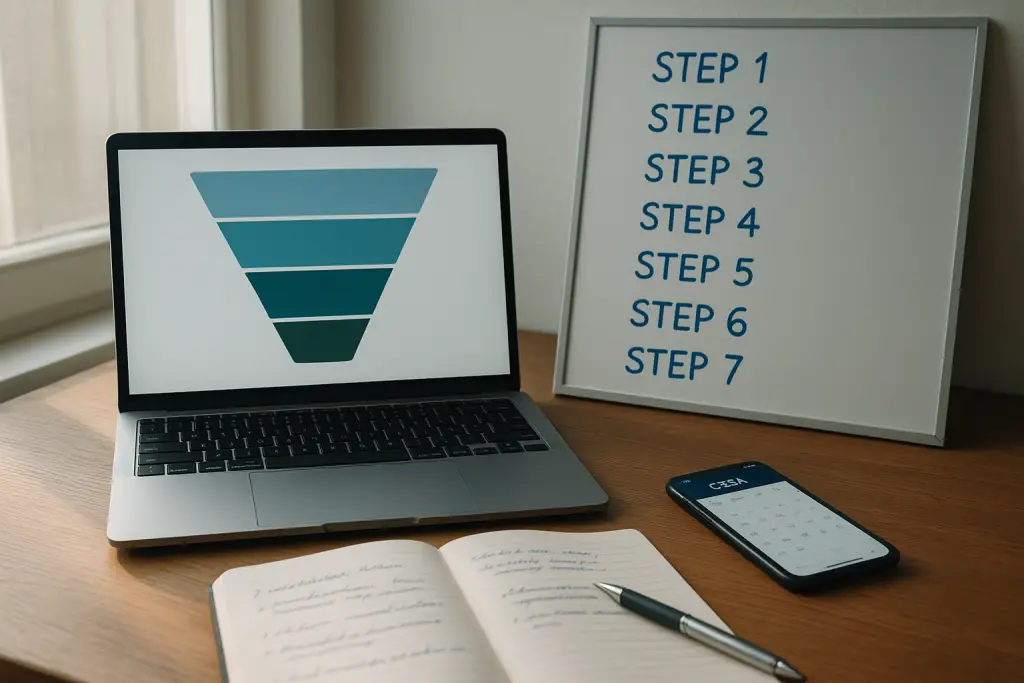
Why qualified leads matter more than “more leads” for creative entrepreneurs
If you teach, coach, or create for a living, you’ve probably felt the quiet panic of an empty calendar or a launch that didn’t land. It’s tempting to think, “I just need more leads.” But more names in your inbox isn’t the win—you need the right people to raise their hands. Qualified leads are the difference between chasing and choosing. They buy your course because it solves a real problem they’ve already tried to fix. They book coaching because your method fits their goals and budget. They join your membership because they see themselves in your promise.
For musicians and creative educators, the stakes are higher than they look. An extra ten unqualified inquiries can drown your week in back-and-forth messages and free advice. Meanwhile, one right-fit piano parent or one choir director who needs your arrangement template can sustain a month of revenue—and open doors to referrals, testimonials, and future product wins. That trade-off—quality over quantity—isn’t just smarter; it’s more sustainable. It gets you off the social hamster wheel and onto assets that compound: a discoverable website, SEO-friendly content, and an evergreen email engine that keeps working even when you’re teaching, resting, or on tour.
The good news? You don’t need a massive team or a 24/7 social presence. You need a clear Lead Generation framework that turns strangers into subscribers, subscribers into qualified leads, and qualified leads into happy customers—without burning you out.
A practical seven‑step Lead Generation framework you can actually run
This seven-step approach was built for creatives who want sustainability, not hustle-for-hustle’s-sake. It puts your website and SEO at the center, uses one flagship digital product (a course, template pack, or membership) to create steady revenue, and layers in automation so your marketing runs when you’re off the clock. It’s simple enough to launch in weeks and strong enough to grow for years.
Let’s build it.
Step 1 — Define your Ideal Customer Profile and buyer personas before you create offers
You can’t generate qualified leads if you’re fuzzy about who’s qualified. Before you make a new worksheet bundle or outline a course, zoom in on the people you can help the most and the problems you solve best. Your Ideal Customer Profile (ICP) is the north star. It describes the “best-fit” buyer for your offers, not everyone who might maybe someday be interested.
Start with three angles: who they are, what they’re trying to accomplish, and how they buy.
- Who they are: role, niche, and context. “Private voice teacher growing a studio in a mid-sized city,” “church music director responsible for weekly arrangements,” or “indie producer monetizing tutorials with a part-time schedule.”
- What they’re trying to accomplish: the concrete outcomes. “Fill 8 more lesson slots in 60 days,” “publish a sellable course without over-recording,” or “rank for ‘beginner piano chords’ on YouTube.”
- How they buy: decision triggers and constraints. Do they pay personally or with school funds? Are they allergic to subscriptions? Do they prefer step-by-step coaching or self-paced templates?
Turn past clients into data: build a simple ICP using firmographics, behaviors, and goals
You don’t need big surveys to get this right. Open your calendar and your Stripe/PayPal history. Which students or customers stuck with you, referred others, and bought the next thing? Which ones churned quickly or needed heavy support? Jot names in two columns. Now look for patterns:
- Firmographics: city size, school vs. private studio, solo creator vs. small team.
- Behaviors: consistent lesson attendance, email open rates, course completion, speed to purchase after joining your list.
- Goals: the words they used—“auditions,” “recital-ready,” “steady bookings,” “less admin.”
From those notes, write a one-paragraph ICP. Keep it scrappy and sharp. For example: “Our best-fit buyer is a private piano teacher in the U.S. or Canada with 12–30 active students, eager to add an online course for passive income, willing to implement SEO basics, and prefers email guidance over live coaching.” That paragraph will steer your messaging, your offers, and the Lead Generation channels you prioritize.
Step 2 — Attract the right audience with discoverable, SEO‑driven content (not just social scrolls)
Here’s the shift that saves creative businesses: treat your website like your primary stage and social media like the afterparty. Social is great for awareness spikes, but search is where intent lives. When someone types “best vocal warm-ups for kids pdf,” they’re not idly scrolling—they’re looking to solve a problem now. That’s your moment.
Start by mapping your ICP’s questions to search. Use straightforward, teachable topics you already know cold. Build a content hub around a flagship product: if you sell a course on “Studio Systems for Busy Music Teachers,” your hub might include posts on lesson scheduling, automated reminders, recital planning templates, and a keyword like “music studio policy template.”
Blog posts are only one lane. Pair them with YouTube tutorials (titled and described with search phrases) and even podcast episodes that answer adjacent queries. The point is to be findable across formats, because your audience consumes differently: a choir director might search on desktop at school; a guitarist might watch your YouTube demo from a phone between gigs.
Map topics to search intent across blog, YouTube, and podcast to feed your funnel
Not all queries are equal. Some are “how” (informational), others are “best” or “template” (transactional). Match content to the moment:
- Blog: in-depth guides, checklists, and comparisons optimized for keywords like “piano lesson website SEO,” “music theory course outline,” or “lead magnet ideas for music teachers.” Include internal links to your lead magnet and product.
- YouTube: performance-based keywords like “Ableton vocal chain tutorial,” “sheet music layout in MuseScore,” or “studio tour for music teachers,” with overlays or mentions that point to your opt-in.
- Podcast: interviews and case studies featuring real teachers or creators implementing your methods—stories often convert better than specs.
SEO compounds. One strong article can rank for years, sending targeted traffic to your opt-in on autopilot. That’s the backbone of sustainable Lead Generation for creatives who’d rather be teaching or recording than constantly posting.
Step 3 — Convert attention into subscribers with a focused lead magnet and friction‑light landing page
Attention isn’t a lead. A lead is someone who traded a bit of information for value because you helped them make progress. The fastest path: one specific promise for one pressing problem. Create a lead magnet that solves a small but meaningful slice of your flagship offer.
If your product is a course on “Recording Vocals at Home,” offer a “90-Minute Home Vocal Booth Setup” checklist with links to budget gear. If you coach music studio owners, offer a “Week-One Studio Systems Starter Pack” with three email templates and a 30-minute workflow video. Keep it laser-focused. “101 Tips” sounds generous but often goes unopened. One crystal-clear win gets used—and when it gets used, trust skyrockets.
Your landing page should read like a friendly performance cue: short headline that names the outcome, one or two lines of clarity, a mockup, and a simple form. Every extra field costs conversions. You can qualify later; at this stage, your only job is to get the right people onto your list and deliver a quick win.
A simple, helpful thank-you page matters more than people think. Show them what to do next: check email, whitelist your address, watch a short “how to use your download” clip, and preview the next step in the journey. When you reduce friction right after the opt-in, open and click rates spike, and your Lead Generation machine starts humming.
Here’s a tiny checklist to keep you honest:
- One outcome-driven headline, one CTA, no detours.
- Proof of usefulness: a 30–60 second teaser GIF or screenshot of the asset in action.
- Mobile-first layout: fast, legible, thumb-friendly.
- Accessibility: captions on your teaser video, alt text on images, color contrast that passes.
Step 4 — Capture only what you need and segment smartly from day one
Collect the smallest amount of data that lets you deliver relevant value. For most creators, that’s first name, email, and one segmentation question that doubles as a promise of personalization. Think “What best describes you?” with 3–4 options tied to different content tracks—“private teacher,” “school music director,” “producer/arranger,” “independent artist.”
When your welcome email references their choice—“As a private teacher, you’ll love the three templates at the end of this email”—it signals that you pay attention. And it keeps your list clean without scaring people off with long forms.
Tag subscribers based on their entry point (the lead magnet they chose), their segment (that one question), and their behavior (clicked the “course syllabus” link, watched 75% of your setup video). Those tags allow you to send the right follow-up without blasting everyone. This is where automation shines: a 5–7 message evergreen sequence can adjust tone and timing based on tags so each person feels like you wrote just for them.
Don’t overcomplicate it. You can run a lean stack: a simple form, a rule that adds one segment tag, and an automated sequence that references their choice. That alone nudges subscribers toward becoming qualified leads—folks who’ve engaged, identified their needs, and now see your paid offer as the logical next step.
Step 5 — Nurture with an evergreen email sequence that builds trust and makes the next step obvious
An evergreen sequence is your reliable bandmate. It shows up the same way every time, hits the right notes, and never tires. Build it once, review it quarterly, and let it work while you’re teaching lessons or finishing a new module.
Think of your sequence in four acts:
Act I: Welcome and quick win. Deliver the lead magnet, show how to use it, and ask a low-friction question that tees up segmentation or reply-based engagement: “What are you working on this semester?” Those replies are gold—they feed content ideas, objection handling, and even product roadmaps.
Act II: Story and authority. Share a short origin story or a student case study. Make it vivid and specific. “Janelle, a choral director in Alberta, shaved three hours off weekly planning using our rehearsal map and finally had time to arrange that student’s solo.” Real names (with permission) or anonymized details build belief faster than generic promises.
Act III: Education and alignment. Teach one core concept from your method that reframes their problem. If you sell a course on SEO for music teachers, explain how a lesson page targeting “piano lessons [city]” with a clear benefit and a call to action consistently outperforms social-only promotion. Link to a deeper post for those who want to dive.
Act IV: Invitation and clarity. Present your offer as the natural next step: “If you loved the rehearsal map, the full ‘Studio Systems’ course gives you seven templates, walkthrough videos, and office hours for the first 30 days.” Don’t hide your price. Don’t bury your guarantee. Transparent details reduce friction and screen out the wrong buyers—a gift to both of you.
Keep the tone personal and paced. Vary plain-text emails with lightly formatted ones that include a screenshot or a short clip. And yes, use AI to draft faster, but keep your voice. A simple rule helps: if you wouldn’t say it in a lesson or rehearsal, don’t put it in your sequence.
Step 6 — Qualify leads with scoring and shared definitions (MQL, SQL) using BANT‑style discovery
Here’s where Lead Generation becomes sales-ready without going “salesy.” You and, if you have one, your sales helper or studio manager need shared definitions. What makes someone a Marketing Qualified Lead (MQL) versus a Sales Qualified Lead (SQL) in your world?
A quick comparison keeps everyone aligned:
You can layer a simple lead scoring model on top: +5 for each email open after the first, +10 for watching a webinar replay, +15 for clicking “pricing,” +25 for booking a call, +30 for completing a readiness quiz. Set a threshold that turns an MQL into an SQL (for example, 60 points). Your email tool or CRM can handle this with tags and rules.
When you do live discovery—whether that’s a 15-minute Zoom, a few DMs, or a short email back-and-forth—borrow the spirit of BANT (Budget, Authority, Need, Timeline) without turning it into an interrogation. For creatives and educators, it sounds like this:
- Budget: “Are you working with school funds or personal budget this semester?”
- Authority: “Is it just you making the call, or should we loop in your department head?”
- Need: “What’s the main bottleneck you’re trying to remove in the next 30 days?”
- Timeline: “If this is a fit, when would you like to start?”
Qualifying doesn’t mean gatekeeping; it means honoring your time and theirs. If someone’s not ready, offer a helpful path—point them to a starter template, a blog series, or your SEO cheatsheet for creatives. When they implement and see a win, they often come back as a stronger fit.
Step 7 — Optimize the system with clear metrics, experiments, and a sustainable channel mix
The beauty of a simple Lead Generation framework is that small tweaks move mountains. You don’t need 27 dashboards—just a handful of numbers that tell a story:
- Traffic to opt-in conversion rate (by source): Is SEO sending more targeted sign-ups than social? It usually does for creators with educational offers.
- Lead magnet delivery open rate and click-through: Did they get and use the thing?
- Welcome sequence completion rate: Are they sticking with you through Act IV?
- Lead score distribution: How many subscribers become MQLs and SQLs each month?
- Sales conversion rate by segment: Do private teachers convert faster than school directors? If so, consider segment-specific landing pages.
Run experiments in tight loops. Swap headlines on your landing page to highlight a more concrete outcome. Test a shorter checklist versus a mini-course as a lead magnet. Try a 10-day “implementation sprint” for new subscribers with one task per day and see if it lifts your MQL-to-SQL rate. Keep experiments focused on one variable at a time so you actually learn.
And protect your energy. A sustainable channel mix balances compounding assets (SEO content, evergreen sequences, recorded webinars) with a lighter cadence on social. Choose one or two social platforms you enjoy and that your ICP actually uses, then set a realistic posting rhythm. Automation can repurpose your pillar content into short clips or carousels. The point is not to be everywhere—the point is to be effective where it counts and free up time to create.
To help you apply the seven steps quickly, here’s a compact, real-world example pulled from creative studios we coach:
- ICP: “Private voice teacher, 20–40 students, wants to add $1–2K/month from a digital product, prefers DIY with light coaching.”
- Attraction: Three SEO-optimized posts (“voice lesson pricing [city],” “beginner vocal warm-ups pdf,” “studio policy template”) plus a matching YouTube tutorial.
- Conversion: Lead magnet = “5-Min Warm-Up Flow + Studio PDF.” One landing page, one CTA.
- Segmentation: One question on the form, “What best describes you?” -> tags version the sequence.
- Nurture: 6-email evergreen series with a case study in email 3 and a course invite in email 5.
- Qualification: Lead scoring to 60 points flips to SQL; discovery calendar link appears only after that threshold.
- Optimization: Quarterly review of keyword rankings, a/b test on lead magnet headline, sequence refresh with newest case study.
When a creator embraces this flow, the result is predictable momentum. Traffic turns into subscribers. Subscribers turn into qualified leads. Qualified leads become customers without you living in your DMs.
Now, let’s stitch together the mindset and the mechanics so you can move today—not “someday.”
You don’t have to rebuild your business to start. Pick one flagship product you’re excited to stand behind for at least a year. Map three search-driven content pieces that point to a single, specific lead magnet. Write a lean, human welcome sequence that teaches, tells one story, and invites the right people into your paid solution. Add simple scoring so your hottest leads get timely, respectful attention. That’s it. You’ve just built the bones of a sustainable Lead Generation engine.
For creative entrepreneurs—especially musicians and educators—the payoff is freedom. Freedom from constant promo. Freedom to work in deep focus and still grow. Freedom to design a business that supports your art rather than competes with it. You’re not chasing trends anymore; you’re building assets that serve your audience and your future self.
If you want a few ready-made boosts, grab the SEO cheatsheet for creatives to map keywords in an hour, swipe our course outline blueprint to shape that flagship product, and explore our AI productivity guide for 2025 to move twice as fast without losing your voice. Then take the first step: draft your ICP paragraph and choose your lead magnet promise. Ten lines and one page. You’ll feel the clarity immediately.
This is your reminder: qualified beats “more.” Systems beat sprints. And your art deserves an engine that runs while you create.