Coaching vs Online Course Creation: a practical framework for creatives choosing the right offer
If you’re an entrepreneur trying to build a business that supports your life instead of swallowing it, this comparison matters a lot. Coaching and online course creation can both be excellent offers, but they solve different problems.
Coaching usually gives you faster cash flow and deeper client transformation, while online course creation gives you more room to scale after the upfront build is done. Professional coaching is generally a client-led, one-to-one process that helps people find clarity, set goals, and take action, while course platforms are built to package expertise into repeatable learning products that can be sold at scale.
How to evaluate time, energy, scalability, and buyer fit before you choose
A good starting point is to compare these two models on four simple criteria:
- How long they take to launch
- How much energy they require to deliver
- How well they scale
- What type of buyer they attract.
Coaching usually wins on speed and intimacy. You can start with a few clients, refine your process, and get direct feedback quickly. Course creation, on the other hand, wins on scalability and leverage. Once the content is built, it can keep selling with relatively little marginal delivery time.
A second filter is audience fit. Coaching tends to work best when buyers want personalized support, accountability, and a faster path through a specific bottleneck. Courses tend to work best when buyers want self-paced learning, a lower-touch option, or a more affordable way to access your method. Creative entrepreneurs often need both kinds of offers at different stages. Someone who needs immediate feedback on pricing, messaging, or client acquisition may be a great coaching fit. Someone who wants to learn a repeatable system on their own schedule may be happier buying a course.
Why coaching feels faster to launch but stays tied to your calendar
Coaching can feel wonderfully simple at the beginning. You do not need to script a full curriculum, build a polished platform, or film dozens of lessons before you sell. Instead, you’re selling your expertise and your ability to help someone make progress in real time. That’s a big reason it’s such a popular first offer for service-based creatives. It’s direct. It’s personal. And it can produce results quickly, which is incredibly useful when you’re still learning what your audience will pay for.
But the same thing that makes coaching appealing also limits it. Your revenue is connected to your availability. If you book five clients, you have five sets of calls to deliver. If you want to scale, you usually have to raise prices, improve retention, or add group formats and other supporting offers. That’s not bad, but it is a ceiling worth acknowledging. Coaching can absolutely be profitable, but it’s still a calendar-based business unless you intentionally build beyond one-to-one work.
The strengths of coaching for creative business owners who want clarity, accountability, and higher-touch support
Coaching shines when the buyer wants nuance. Creative entrepreneurs often juggle messy realities: irregular income, multiple revenue streams, uncertain offers, and the emotional weight of marketing themselves. A coaching container gives room to talk through the whole picture instead of forcing everything into a prebuilt framework. That matters when someone is trying to refine a niche, set prices, streamline systems, or finally stop undercharging. Because the conversation is customized, coaching can feel more relevant than generic business advice.
It also helps with accountability. Many buyers do not need more information; they need a clearer next step and a human being who will ask the hard questions. That’s especially true for creatives who are talented at their craft but overwhelmed by the business side. If you’ve ever had a client or student say, “I know what to do, I just can’t make myself do it,” you already understand the value of coaching. It can turn scattered effort into focused action.
The tradeoffs: delivery capacity, client bandwidth, and the ceiling on revenue per hour
The downside is straightforward: coaching is labor-intensive. Each client needs your attention, your presence, and your time. Even if your systems are tight, you still have to show up. That means your income is tied to the number of sessions you can realistically handle. If you’re a freelance musician, teacher, or creative with multiple commitments, that can become a pressure point fast.
There’s also the issue of client bandwidth. Coaching works best when clients are ready to participate actively. Coaching is a collaborative, client-led process, which means the client has to bring willingness, reflection, and follow-through. If they want you to do all the thinking for them, coaching can get frustrating on both sides. That’s not a flaw in the model; it’s just a reminder that coaching depends heavily on the client’s level of readiness.
And then there’s the price-to-time ratio. Coaching can command premium pricing because the support is personalized, but premium pricing doesn’t automatically solve the scalability problem. If you want a business that keeps growing without adding more hours, coaching alone usually isn’t enough. It’s powerful. Just not infinitely expandable.
Why online course creation can scale farther after the upfront work is done
Online course creation is built for leverage. You create the lessons once, structure the journey, and then sell that same asset again and again. That’s a major reason course platforms talk so much about scalability, recurring revenue, and expansion without technical constraints. Thinkific and Teachable both position online courses as products that can be sold continuously after the upfront work is done, and both platforms emphasize tools that make it easier to create, market, and sell learning products from a single system.
For creatives, this can be a beautiful fit. If you teach music, art, content strategy, SEO, or business systems, a course lets you package your method into something that can help more people without requiring your direct presence every time. That’s where online course creation starts to feel different from coaching. It’s less about live conversation and more about building a repeatable teaching asset. And that asset can support passive or semi-passive income if you market it well.
The strengths of courses for passive income, repeatable teaching, and audience growth
The biggest advantage of a course is leverage. You can sell to one person or one thousand, and the delivery model stays mostly the same. That’s a powerful thing if your goal is to build income that doesn’t depend on your availability every week. Teachable explicitly says online course creation is designed for longevity, meaning the up-front work can keep paying off over time. Thinkific also highlights features like course builders, landing pages, pricing tools, and support for recurring revenue through digital learning products.
Courses also scale your expertise in a cleaner way than repeating the same explanation over and over on sales calls. If you’ve ever found yourself re-teaching the same concept to every client, that’s a strong signal that a course may be the better next step. It lets you document your process, build authority, and create a structured path for people who want self-paced learning. For creative online business owners, that can mean less one-off delivery and more room to build a business around your strengths.
The tradeoffs: longer build time, marketing demands, and the challenge of creating a course people actually finish
Of course, online course creation is not magic. It takes time to design the curriculum, decide on the transformation, record or write the materials, and build a sales page that makes sense to your audience. Some platforms can speed this up with AI outline generators, templates, and drag-and-drop builders, but the front-loaded work is still real.
There’s also the marketing challenge. A course can be beautifully made and still underperform if your audience doesn’t understand the outcome or trust the path. This is where SEO becomes a quiet superpower. Organic visibility can help a course keep attracting the right people without relying entirely on social media. That’s especially useful for creatives who are tired of chasing attention every day and want a more stable discovery channel. Search traffic may take longer to build, but it can support a far more sustainable model over time.
And then there’s completion. A course only works if people move through it. If the lessons are too vague, too long, or too disconnected from the buyer’s real problem, completion rates can suffer. A good course needs more than information. It needs structure, momentum, and a clear result.
Pricing, positioning, and profit: how creative entrepreneurs can think about value in each model
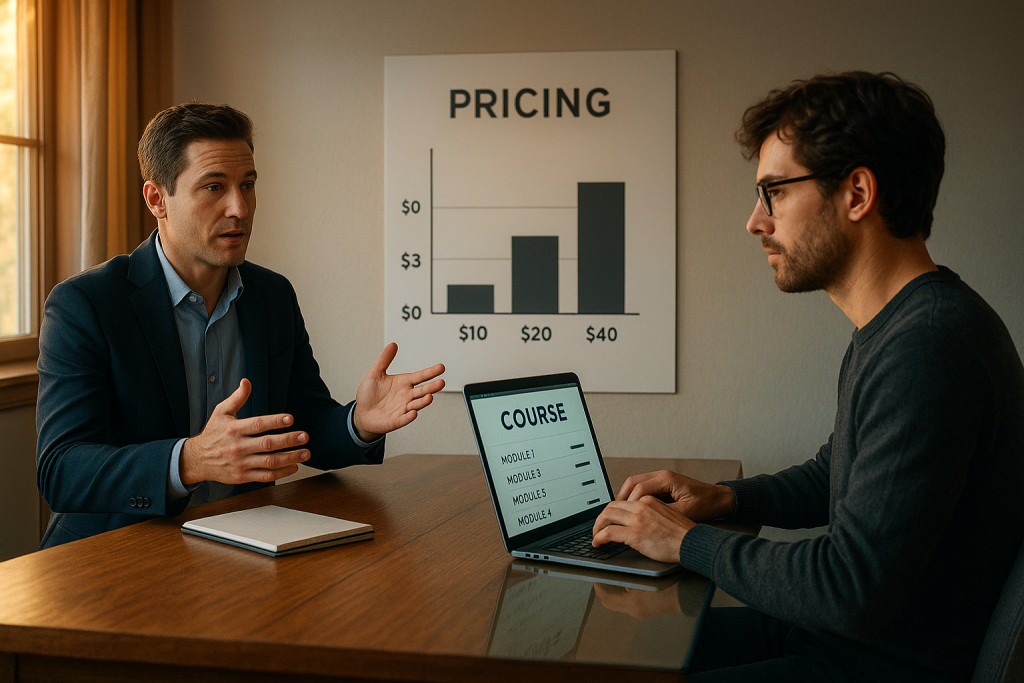
Pricing is where the differences between coaching and course creation really start to show. Coaching is generally easier to price at the higher end because buyers are paying for access, personalization, and real-time support. Courses are usually priced lower because they’re self-paced and less customized, though premium courses absolutely exist when the promise, brand, and transformation are strong. Kajabi even notes that course creators can price in different ways depending on whether they want to compete on quality, value, or accessibility.
For creatives, this means the question is not “Which one should be cheap?” It’s “What kind of value am I offering, and how much support does it require?” If you’re helping someone make a deeply personal business decision, coaching may justify a higher price. If you’re teaching a repeatable system that can help many people, a course can be priced more accessibly while still generating meaningful revenue through volume.
What typically supports premium coaching pricing versus more accessible course pricing
Premium coaching pricing is often supported by specificity. The more tailored the result, the easier it is to charge for it. A creative business owner might pay more for help refining an offer, fixing a sales funnel, or building a sustainable pricing model because those outcomes are tied directly to revenue and confidence. Coaching is also easier to position as a high-trust relationship, which can raise perceived value.
Courses, by contrast, usually need broader appeal and clearer packaging. The value has to be obvious fast. What will this help me do? How soon will I get a result? Why should I trust this method? Because the product is less personalized, buyers often expect a lower price point than coaching, even when the transformation is significant. That’s why creators often use courses as a scalable entry point and coaching as a higher-touch upsell. It’s a smart ladder when it’s built intentionally.
How niche expertise, testimonials, and SEO-driven visibility can influence conversions
Niche expertise matters because it makes your offer feel specific rather than generic. For a creative entrepreneur, that specificity can be the difference between “interesting” and “yes, this is for me.” Public-facing course and coaching platforms also increasingly highlight testimonials, customer success, and proof of results because trust is a major factor in conversion.
SEO strengthens that trust over time. When your content shows up for the exact problem someone is trying to solve, you arrive as a helpful authority instead of a stranger interrupting their scroll. That matters a lot for creatives who want to sell without excessive promotion. Organic visibility can lower the pressure to constantly “be on” and instead let your content do the heavy lifting.
Which model fits which creative business stage, lifestyle, and growth goal
A lot of people ask whether they should start with coaching or with a course, and the most honest answer is: it depends on where you are. If you need faster income and want to learn directly from real client conversations, coaching is often the smarter first move. If you already know your method, have a defined audience, and want to build a more scalable asset, online course creation may be the better long-term play. Thinkific, Teachable, and Kajabi all reflect this broader market reality: creators want ways to turn expertise into recurring revenue, memberships, and digital products, not just one-off sessions.
There’s also a lifestyle question here. Some creatives genuinely love direct support work. They thrive in conversations, in problem-solving, in real-time transformation. Others want a business that gives them more margin, more time for their art, and less dependence on booked calls. Neither is wrong. The best model is the one that aligns with your energy and your business goals, not the one that sounds most impressive on paper.
When coaching is the smarter first offer and when online course creation becomes the better long-term asset
Coaching is often the better first offer if you’re still refining your process. You get paid to learn what your audience actually needs. You’ll hear objections, see patterns, and discover which outcomes matter most. That feedback can later shape a stronger course. For many creatives, coaching is the research phase that pays the bills while the bigger digital product is taking shape. That’s a very practical path, and it’s one that respects your time.
Online course creation becomes the better long-term asset when the method is repeatable and the audience is clear. If you can teach the same transformation over and over without reinventing it each time, a course can make a lot of sense. The initial build takes effort, but the resulting product can sell while you’re teaching, creating, traveling, or simply protecting your calendar. That kind of leverage is a huge win for creatives who want freedom and stability at the same time.
How many creatives combine both models to build sustainable revenue without hustle culture
The smartest businesses often don’t choose one forever. They use both. Coaching can be the premium, high-touch offer. The course can be the scalable, lower-touch offer. Together, they create a ladder that serves different buyers at different stages. Someone may start with a course, then move into coaching when they want more personalized support. Another person may start in coaching, then buy your course later as a self-paced reference tool.
A decision path for choosing your next step with confidence
So how do you decide? Start with the question that matters most: Do I need speed, scale, or both? If you need faster cash flow and want to validate your ideas, coaching is usually the cleaner choice. If you want a product that can keep selling without your direct presence in every sale, online course creation is probably the stronger bet. And if you want the best of both worlds, build coaching first, then use what you learn to create a course that captures the patterns, language, and wins your clients keep asking for.
The creator economy is growing, and the market for digital education keeps expanding as more people look for flexible ways to learn and earn. Goldman Sachs projected the creator economy could approach $480 billion by 2027, while McKinsey’s recent work continues to show strong growth across high-growth digital sectors. That doesn’t mean every course or coaching offer will succeed automatically, but it does show that expertise-based businesses are still expanding in meaningful ways.
What to do if you want faster cash flow, more freedom, or a more scalable business model
If you want faster cash flow, start with coaching. If you want more freedom from your calendar, start planning a course. If you want a business that can grow with less hustle, consider building both in sequence. The key is to stop asking which model is objectively “better” and start asking which one fits your current stage and your next goal. That answer is usually much clearer than people expect.
And if you’re a creative entrepreneur who wants to sell your offers without shouting into the void every day, this is where SEO, niche positioning, and thoughtful product design come together. Coaching can help you get there faster. Online course creation can help you stay there longer. The real win is building a business that supports your talent, your energy, and the life you actually want to live.